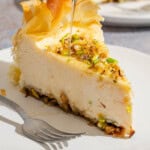
Baklava Cheesecake
Does it get much better than a combination of nutty, flaky baklava and fluffy orange-scented cheesecake? I think not! This recipe looks fancy but is surprisingly easy, with no rolling, kneading, or water bath required.
Servings: 16 pieces
Ingredients
For the Phyllo Crust
- Extra virgin olive oil
- 1/3 cup walnuts, chopped, plus more chopped walnuts for garnish
- 1/3 cup pistachios, chopped, plus more chopped pistachios for garnish
- 2 tablespoons sugar
- 1 teaspoon ground cinnamon
- 10 sheets phyllo dough, thawed if frozen
For the Cheesecake
- 3 pounds whole milk ricotta cheese, strained and room temperature
- 8 large eggs, at room temperature
- 1 1/4 cups sugar
- 1 teaspoon vanilla extract
- 2 large oranges, zested (divided)
- 1/4 to 1/3 cup honey
Instructions
- Get ready. Position a rack in the middle of your oven and heat to 350°F. Brush a 10-inch springform cake pan with olive oil, then set on a large sheet pan.
- Make the nut mixture: In a small bowl, mix together the walnuts, pistachios, sugar, and cinnamon. Set aside for now.
- Assemble the phyllo crust: Lay two sheets of phyllo in the oiled springform pan and press gently onto the bottom and sides. Brush the phyllo with olive oil, including any parts hanging over the pan. Lay another 3 sheets of phyllo on top so they overlap, rotating the pan so that the phyllo will cover it on all sides (there should be phyllo slack hanging over on all sides of the pan). Brush with olive oil, then sprinkle the nut mixture over the phyllo to cover the bottom of the pan. Place the remaining phyllo sheets over the nut mixture, following the same pattern and making sure to brush each sheet of phyllo with olive oil. (If the overlay of phyllo dough is too long, you can fold it over or cut it with a pair of kitchen scissors).
- Prepare the cheesecake batter: To the bowl of a standing mixer fitted with a paddle attachment, add ricotta, eggs, sugar, vanilla extract, and half of the orange zest. Start the mixer on low for 1 to 2 minutes, then increase the speed to medium-low (2 on the KitchenAid mixer) for 10 minutes. The mixture will look light and fluffy. (If using a hand-mixer, keep the speed low. If using a wooden spoon, mix continuously until fluffy.)
- Assemble and bake the baklava cheesecake: Pour the batter into the prepared pan with the phyllo. Place the cheesecake in a preheated oven for one to 1 1/2 hours, or until the batter has mostly firmed up and the top of the cake and phyllo crust has gained a nice golden brown color. The batter may still jiggle slightly in the middle, but it will firm up once cooled. (Keep an eye on the phyllo crust–if it is turning too brown too quickly, adjust the heat to 325°F.)
- Cool: Remove from the oven and place on a wire rack to cool for 1 to 2 hours. Transfer to the fridge for at least 6 hours, or overnight.
- Finish and serve: Put the honey in a glass bowl set inside a bowl of warm water to gently warm. Let it sit for 5-10 minutes, stirring occasionally until it loosens and becomes pourable. Break off any extra phyllo crust hanging over the sides of the cheesecake that could make it difficult to release. (You can crumble the crust and add it on top to garnish). Release the lever on the side of the pan, remove the cake and transfer to a platter. Garnish with more chopped nuts and the remaining orange zest, then drizzle with the warmed honey. Enjoy!
Video
Notes
- Shop this recipe: Visit our shop to browse quality Mediterranean ingredients, including the olive oil used in this recipe.
- To defrost frozen phyllo dough: Place in the fridge (still wrapped in its package) for at least 8 hours, or overnight. If it still feels slightly frozen, allow it to sit at room temperature for an hour before using.
- To freeze:
-
- Portion the cheesecake into slices.
- Wrap each slice tightly in plastic and then cover with a layer of foil.
- To defrost, place the slice in the fridge for 5-6 hours.
- Frozen baklava cheesecake will last up to 2 months in the freezer. Keep in mind that, while delicious, the phyllo crust will not be as crispy.
Nutrition
Calories: 312.6kcal | Carbohydrates: 27.8g | Protein: 14g | Fat: 16.6g | Saturated Fat: 8.2g | Monounsaturated Fat: 5.1g | Trans Fat: 0.01g | Cholesterol: 125.2mg | Sodium: 154.5mg | Potassium: 168.5mg | Fiber: 0.7g | Sugar: 18.9g | Vitamin A: 508.8IU | Vitamin C: 0.2mg | Calcium: 196.4mg | Iron: 1.3mg
QR code
Scan this QR code with your phone's camera to view this recipe on your mobile device.
