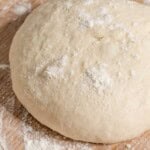
Neapolitan Pizza Dough Recipe
The dough itself needs just four ingredients and no kneading. Mix it the night before, then let the long, slow rise create a flavorful Neapolitan-style pizza crust that is lightly crisp outside, tender and airy within. For the softest texture, use 00 pizza flour; bread flour also works.
Servings: 6 Makes 2 (12 to 14-inch) pizzas
Equipment
- Pizza Stone (see note for alternatives)
Ingredients
- 3 cups 00 flour or bread flour, plus more for dusting
- 1/4 teaspoon instant yeast
- 1 1/4 teaspoons kosher salt
- 1 cup tepid water
- Extra virgin olive oil (optional), for brushing
- Your favorite sauce and toppings
Instructions
- Mix the dough. In a large mixing bowl, whisk together the flour, yeast, and salt. Pour in the water and stir with a wooden spoon until a shaggy dough comes together and no dry flour remains.
- Let the dough rise. Cover the bowl and leave it to rise at room temperature for 12 to 18 hours. I usually do this overnight.
- Shape the dough. Dust your hands and a work surface with flour. Scrape the dough out of the bowl and onto the floured surface. Use a bench scraper or sharp knife to divide the dough in half for larger or thick-crust pizzas, or into three pieces for smaller or thin-crust pizzas. Shape each piece into a ball.
- Rest the dough. Set the dough balls seam-side down and let them rest uncovered on the counter for at least 30 minutes. Alternatively, cover them with a damp tea towel and let them rest for up to 2 hours.
- Get ready to bake. While the dough rests, place a pizza stone in the oven and preheat to 500°F.
- Stretch the dough. If you divided the dough in half, stretch each piece into a rough 12- to 14-inch circle. Use your palms to press outward from the center, then gently pull and stretch it from the edges. If the dough sticks, dust the surface with more flour. Leave the outer edge slightly thicker than the center to form the crust.
- Transfer to parchment paper. Cut a piece of parchment paper into a round about the same size as the pizza. Set the parchment on a pizza peel, cutting board, or the back of a sheet pan. Carefully transfer the stretched dough onto the parchment
- Add the toppings: Lightly brush the dough with extra virgin olive oil. Add your favorite sauce and toppings
- Bake. Reduce the oven temperature to 450°F. Carefully slide the pizza and parchment onto the hot pizza stone. Bake for 9 to 12 minutes, until the crust is golden brown and any cheese begins to bubble.
- Repeat and serve. Remove the finished pizza and repeat with the remaining dough.
Notes
- Shop this recipe: Visit our shop to browse quality Mediterranean ingredients, including the Nocellara Italian extra virgin olive oil used for brushing.
- Try these toppings: I especially love this dough with Tuna Pizza with Onions and Black Olives.
- To use a baking sheet: Line it with parchment paper. It does not need to preheat like a pizza stone does.
- To use a cast-iron skillet: Generously grease the skillet with olive oil. It does not need to preheat.
- Allow more time without a stone: Begin checking after 12 minutes. Carefully lift the crust with a spatula; the underside should be golden and should no longer look or feel doughy.
- For additional browning: Finish the pizza under the broiler for 1 to 2 minutes, if desired, watching it constantly. Parchment paper is generally rated to 450°F, and exposed parchment may scorch.
- For a same-day dough: Double the instant yeast to 1/2 teaspoon. Mix the dough in the morning and let it rise, covered, at room temperature for about 8 hours.
- To make ahead: Keep the unbaked dough balls in a covered bowl or wrap them in plastic, then refrigerate for up to 3 days. Let them come to room temperature for 2 to 3 hours before stretching and assembling the pizzas.
Nutrition
Calories: 227.3kcal | Carbohydrates: 45.5g | Protein: 7.7g | Fat: 1.1g | Saturated Fat: 0.2g | Polyunsaturated Fat: 0.5g | Monounsaturated Fat: 0.1g | Sodium: 486mg | Potassium: 67.4mg | Fiber: 1.6g | Sugar: 0.2g | Vitamin A: 1.3IU | Vitamin C: 0.002mg | Calcium: 9.8mg | Iron: 0.6mg
QR code
Scan this QR code with your phone's camera to view this recipe on your mobile device.
