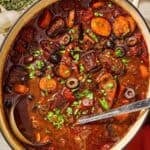
Daube Provençale
Travel to the South of France with this iconic Provençale beef stew. The beef slowly braises on the stovetop in an aromatic and herbaceous red wine broth.
Servings: 8
Ingredients
- 4 tablespoons extra virgin olive oil, divided
- 2 pounds boneless beef chuck, cubed
- Kosher salt
- Freshly ground black pepper
- 1 large yellow onion, finely chopped
- 3 garlic cloves, thinly sliced
- 3 medium carrots, sliced
- 2 medium tomatoes, coarsely chopped
- 1 tablespoon tomato paste
- 2 wide strips orange zest (peeled with a vegetable peeler)
- 4 whole cloves
- 1 whole star anise
- 2 teaspoons Herbes de Provence
- 2 cups red wine
- 1 cup water, plus more if needed
- 2 bay leaves
- 1/2 cup pitted black olives (about 3 1/2 ounces)
Instructions
- Brown the beef in batches. In a Dutch oven or heavy-bottomed pot, heat 2 tablespoons olive oil over high heat. Add the meat in a single layer (you will need to do this in batches so as not to overcrowd the pot), seasoning liberally with Kosher salt and black pepper. Turn the meat until lightly browned on all sides, about 30 seconds to 1 minute per side. Transfer the browned pieces to a plate and set aside.
- Sauté the aromatics and veggies. Add the remaining 2 tablespoons olive oil to the pot and lower the heat to medium-high heat. Add the onion and sauté until slightly caramelized and translucent, about 4 minutes. Stir in the garlic, carrots, tomatoes, tomato paste, orange zest, cloves, star anise, and Herbes de Provence. Allow this mixture to caramelize for about 2 minutes, then return the meat and its accumulated juices to the pot and stir to coat with the aromatics.
- Deglaze the pan. Pour the red wine and water into the pot, scraping the bottom with a wooden spoon to release any fond. The meat should be fully submerged with allowance for small bits to be poking out of the water (you may add a little more water if needed). Let it come to a boil for 3 minutes to allow some of the alcohol to evaporate.
- Simmer. Add 2 teaspoons salt to the pot, along with the bay leaves, and give everything a stir. Turn the heat down to low or medium-low—you want a slow simmer—and cover the pot. Cook until the meat is tender and the sauce is slightly thickened. This takes about 4 hours 30 minutes. Halfway through cooking, open the lid, give it a stir, and check to make sure there is still enough water, adding more if necessary. In the last hour, you can crack the lid of the pot slightly to allow some slow evaporation to aid in the sauce reduction.
- Finish and serve. In the final 15 minutes, stir in the black olives. The meat is ready when it’s nice and tender, easily breaking apart when you push it with a wooden spoon. Serve the daube over pasta, rice, steamed potatoes, or, scoop it up with crusty bread.
Notes
- Shop this recipe: Visit our shop to browse quality Mediterranean ingredients, including the olive oil and olives used in this recipe.
- Make it Ahead: The leftovers of a daube are always a treat as, like many stews, they taste even better the next day. Make it a day ahead, cool it thoroughly, and then reheat it to experience the best of it. Some of the fat will solidify on top of the stew once chilled. You can leave it in or remove some or all of it before reheating it, if you like. It can be kept refrigerated in an airtight container for 3 days, or frozen for up to 3 months. Reheat on the stovetop until it bubbles for the best results.
Nutrition
Calories: 357.3kcal | Carbohydrates: 8.4g | Protein: 22.8g | Fat: 21.5g | Saturated Fat: 6.9g | Polyunsaturated Fat: 2g | Monounsaturated Fat: 12.7g | Trans Fat: 0.8g | Cholesterol: 78.2mg | Sodium: 261.9mg | Potassium: 658.6mg | Fiber: 2.1g | Sugar: 3.2g | Vitamin A: 4181.8IU | Vitamin C: 11.6mg | Calcium: 57.2mg | Iron: 3.4mg
QR code
Scan this QR code with your phone's camera to view this recipe on your mobile device.
