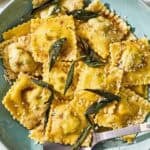
Spinach Ricotta Ravioli
Spinach and ricotta ravioli was one of the first pastas I learned to make, standing across the kitchen counter from my mom. Fresh baby spinach, creamy ricotta, Parmigiano-Reggiano, and a pinch of nutmeg make a light, savory filling. I finish them with nutty brown butter and crispy sage, though my mom always served hers with marinara. Either way, this fresh pasta recipe is well worth the time.
Servings: 6
Ingredients
For the Pasta:
- 2 1/4 to 2 1/2 cups (300g) “00” soft wheat pasta flour or unbleached all-purpose flour, plus more for dusting the work surface
- 3 extra large eggs or 3 large eggs + 3 tablespoons water, all at room temperature
For the Spinach Ricotta Filling:
- 12 ounces fresh baby spinach leaves
- 2 cups ricotta cheese, well-drained
- 1/3 cup freshly grated Parmigiano cheese, plus more for serving
- 1 large egg (optional), lightly beaten
- 1/2 teaspoon fine salt
- Freshly grated nutmeg
For the Sage Sauce (optional):
- 3 tablespoons salted butter
- 3 tablespoons extra virgin olive oil
- 1 small bunch fresh sage
Instructions
Make the Pasta
- Make a well. Mound the flour onto a clean work surface. Use the back of your hand or the bottom of a bowl to create a wide, shallow well in the mound. The “walls” of the mound should be just high enough to keep the eggs in the well.
- Add the eggs. Break the eggs into the flour well and beat lightly, but thoroughly with a fork. Beat in 3 tablespoons of water if you used large, rather than extra large, eggs.
- Mix the pasta dough. Use a fork to mix the eggs in a circular motion, slowly incorporating the flour from the inner wall of the well as you mix. When the mixture has thickened to a pasty consistency, begin using your fingers and a bench scraper to incorporate more flour. Continue to mix until a rough, sticky dough has formed.
- Knead the pasta dough. Knead the mixture by hand until you have incorporated most, or all of the flour and the dough has a nice, firm, bouncy consistency. Adjust the texture by incorporating more flour or a spritz of water, as needed. Continue to knead for 5 to 10 minutes, until the dough is smooth, firm, and supple. Wrap the dough in plastic wrap and let it rest at room temperature for 45 to 60 minutes.
Make the Spinach-Ricotta Filling
- Steam the spinach. Wash the spinach and place it in a large skillet or saucepan with the water still clinging to the leaves. Cover and cook over medium-low, turning occasionally, until the spinach is completely wilted and tender, but still a bright, dark green, about 5 to 8 minutes.
- Chop the spinach. Transfer the spinach to a colander set in the sink and let sit until cooled enough to handle, then squeeze out as much liquid as possible. Transfer it—now a dense blob of green—to a chopping board and chop finely.
- Make the filling. Place the spinach and drained ricotta in a large bowl. Add 1/3 cup freshly grated Parmigiano cheese, the beaten egg, salt, and nutmeg. Mix everything together thoroughly. Cover and refrigerate.
Form the Ravioli
- Get ready. Remove the filling from the refrigerator and set up your pasta machine or mixer with the pasta attachment, making sure the pasta roller is at its widest setting (#1 on my hand-crank machine). Sprinkle a little flour on a cleared area around the machine or mixer. Line two rimmed baking sheets with clean kitchen towels and sprinkle them with flour. This is where you will put your ravioli once you’ve formed them.
- Divide the pasta dough. Cut the ball of dough into 4 quarters and rewrap three. Knead the remaining piece briefly on the work surface. With a rolling pin or the heel of your hand, flatten it into a thick oval 3- to 4-inches long.
- Roll a dough rectangle. Feed the dough through the pasta machine and then lay it on the work surface. Fold the dough into thirds, as though you were folding a business letter. Sprinkle lightly with flour and pass it through the rollers again. Repeat the folding and rolling process one or two more times to help set the rectangular shape of the dough.
- Sheet the pasta. Move the roller setting to the next narrower notch and feed the strip of dough through the setting twice, sprinkling it with a little flour if needed to keep it from sticking. Continue to pass the dough through the rollers twice on each setting until it is about 1/16-inch thick—#5 on my machine. The sheet should just be thin enough to see the shadow of your hand through it.
- Add the ravioli filling. Position the strip of pasta on a lightly floured work surface. Mound 1 to 2 teaspoons of filling at 1 1/2-inch intervals along the length of the strip, slightly below center.
- Seal the ravioli. Dip a finger in water and moisten along the bottom edge of the strip and around each mound of filling. Carefully fold the top of the strip, lengthwise, over the filling so that the top edge meets the bottom edge. Press all around the mounds of filling to squeeze out any air and to seal them.
- Cut the ravioli. Use a fluted pasta cutter to cut around each mound to create half-moon or square ravioli. Use a fork to seal them, and set them on one of the towel-lined baking sheets. Make sure the ravioli are not touching, as they might stick together.
- Repeat and rest. Repeat this process with the remaining pasta dough. You should end up with 40 to 50 ravioli. Let the ravioli air dry slightly, for about 30 minutes, while you prepare to cook them.
Cook the Ravioli
- Get ready. Fill a wide high-sided saucepan 1/2 to 3/4 full of water and bring it to a boil over high heat. Warm a serving dish or individual bowls.
- Make the Sage Sauce (optional). While the water heats, melt butter and olive oil together in a small saucepan over medium heat. Add sage leaves. Cook, swirling the pan, until the butter browns and smells nutty and sage is lightly browned and crisp, 3 to 5 minutes. Remove from heat. Alternatively, warm 2 to 3 cups marinara or your favorite pasta sauce to serving temperature.
- Cook the ravioli. Once the water boils, add 1 tablespoon salt and reduce heat to medium-high. The water should not be at a rolling boil, or the ravioli may get tossed around, causing them to tear. Carefully drop ravioli into the pot, cooking them in batches to avoid crowding the pot. Cook until they are just tender and they float to the surface, for about 5 minutes. Scoop them up, a few at a time, with a large skimmer, taking care to let excess water drain off.
- Finish and serve. Place the ravioli in either the warmed serving bowl or in individual bowls and spoon sauce over them. Sprinkle Parmigiano cheese on top, finish with a few crispy sage leaves, and serve.
Notes
- Shop this recipe: Visit our shop to browse quality Mediterranean ingredients, including the olive oil used in this recipe.
-
Spinach Ravioli Tips:
- Weigh the flour. I strongly recommend measuring the flour for ravioli by weight (300 grams) for the most precise results. To measure by volume, lightly spoon the flour into measuring cups and sweep off the excess.
- Check your eggs. The general flour-to-egg ratio is one egg per every 100 grams of flour, but it’s not a precise measurement. Eggs come in different sizes. Some have large yolks, some have more whites. This recipe is based on extra-large eggs. When using standard eggs labeled ‘large,’ I often add a small amount of water to my pasta dough to achieve the right consistency.
- Add egg to the filling, or skip it. Egg helps to bind the filling, but I consider it an optional addition. More than a few times, I’ve forgotten to add the egg to my spinach and ricotta filling and the results have been delicious. Add the egg if you prefer a slightly more compact and solid filling.
- Drain the ricotta. If the ricotta is loose or watery, wrap it in a piece of cheesecloth or several layers of paper towel and squeeze out the excess whey. Once drained, measure out 2 cups—about 1 pound for this recipe.
- Adjust the dough texture. If the pasta dough feels sticky, knead in more flour until it is firm and only slightly tacky. If it feels dry, moisten your hands with a little bit of water or spritz the dough with a spray bottle and knead it into the dough.
- Choose a wide pan. Use a wide, high-sided saucepan rather than a deep pasta pot to cook your ravioli. Ravioli are delicate and tumbling around in a deep pot of boiling water could cause them to tear.