
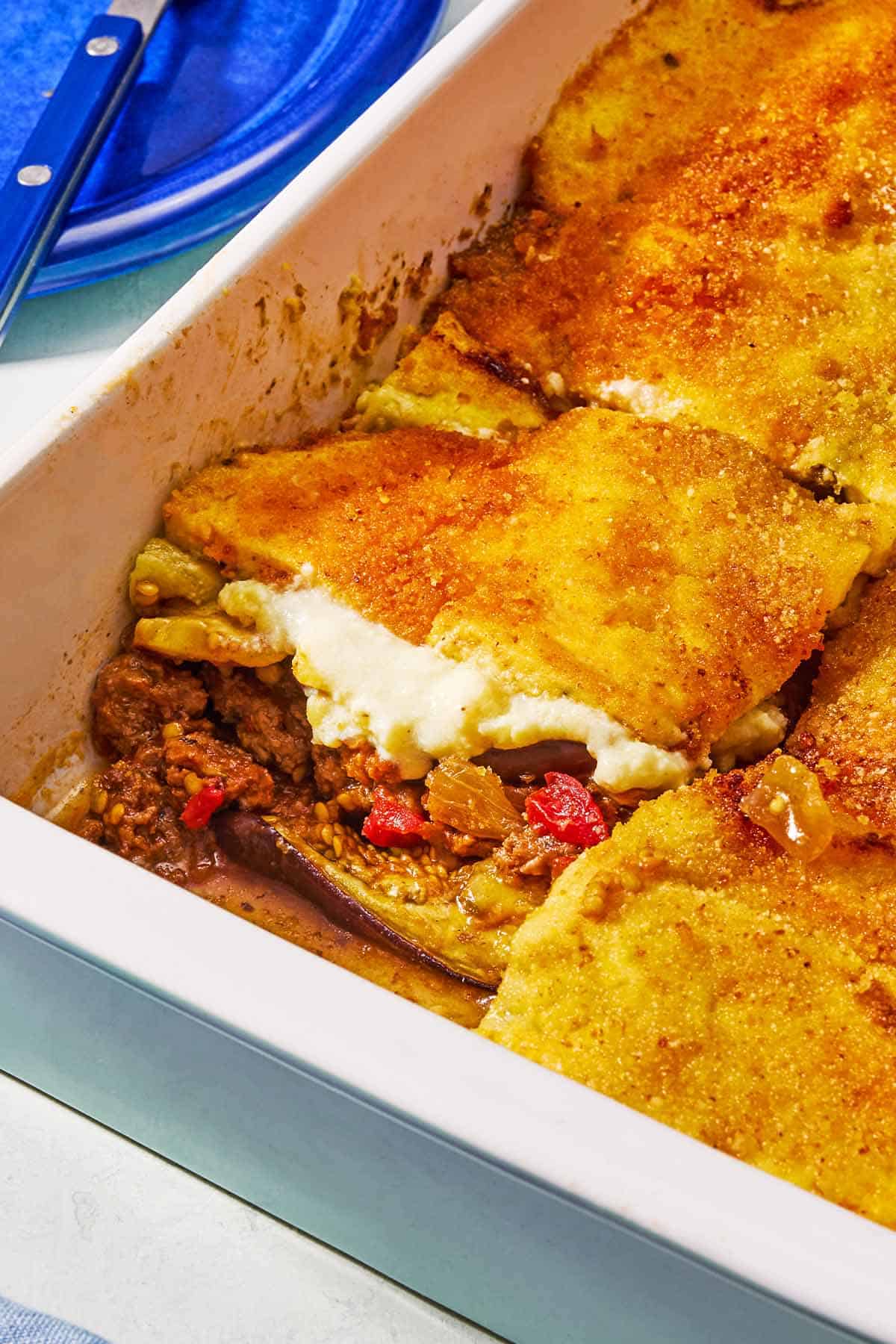
Learn how to make moussaka, with layers of tender roasted eggplant, fragrant meat sauce, and creamy Greek bechamel. This traditional Greek moussaka recipe is easier to put together than you may think!
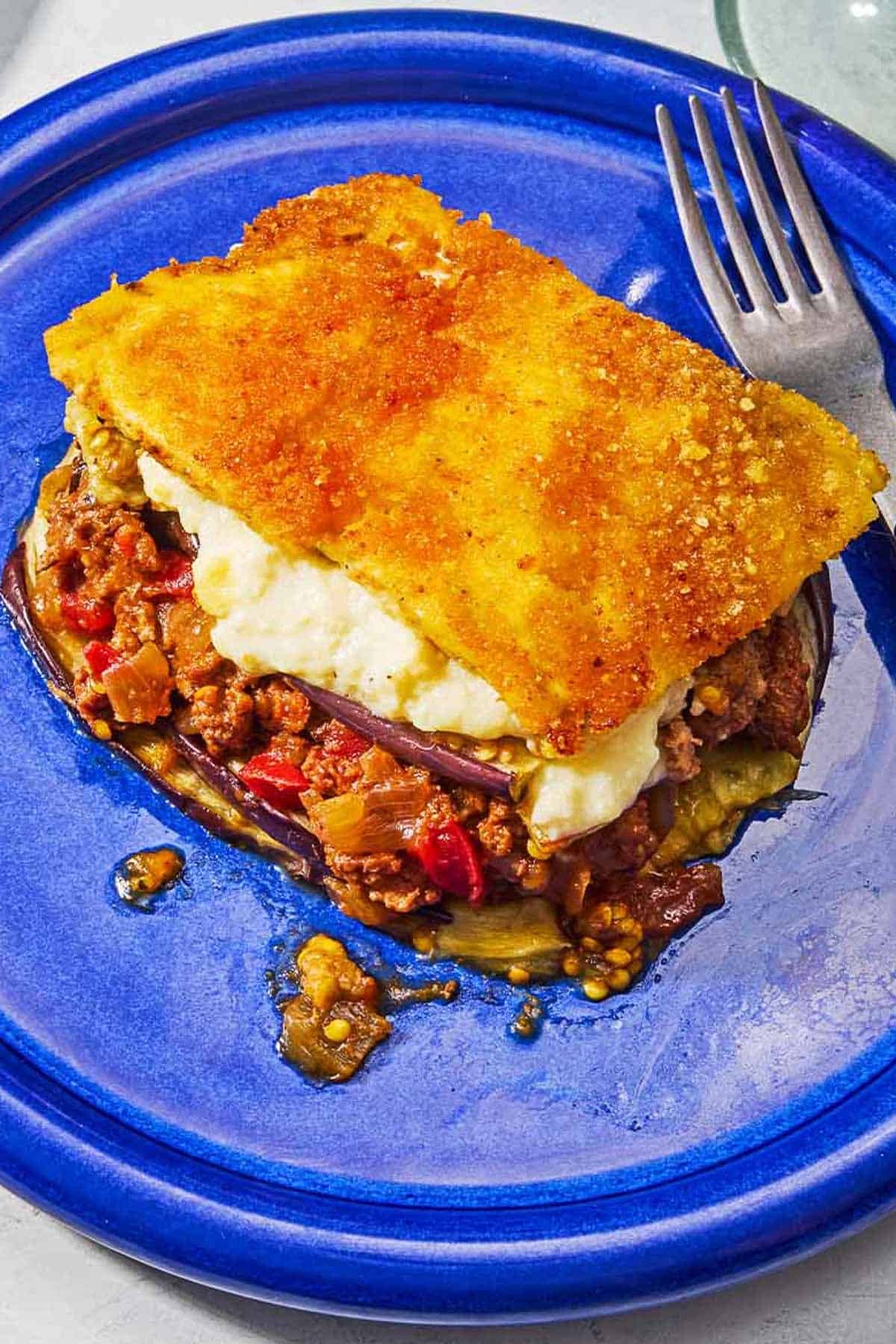
What is Moussaka?
Moussaka (pronounced moo-sa-ka’a) is sort of a Greek eggplant and beef casserole with layers of eggplant, potatoes, a rich and fragrant meat sauce, and topped with a creamy bechamel sauce. You can say that moussaka to the Greeks is like lasagna to Italians, only without the pasta. And the beef sauce for moussaka is laced with hints of cinnamon, nutmeg, oregano, and paprika. It is best kind of comfort food. No wonder it’s one of Greece’s most famous dishes, and mine too!
Why You’ll Love This Recipe
- Moussaka is the perfect make-ahead dish and a seriously comforting dinner casserole.
- It freezes really well. Make one now and freeze. Future you will thank you.
- This easy recipe sticks to traditional Greek flavors and is very comforting, but it gives you a major shortcut: baking the eggplant instead of frying. Greek cooks do the same nowadays. The clean up is a lot easier + your moussaka is a tad lighter.
The Moussaka I Learned in Greece
I grew up with Egyptian moussaka, where we swap the bechamel topping for pine nuts. I’ve since spent many summers in Greece, where I’ve learned to make moussaka the Greek way. This recipe, which I’ve perfected over the years, is how my Greek friends serve moussaka in their homes.
Moussaka is not difficult to make, and if you’ve made lasagna, you can make this! It can be a bit time-consuming, but the good news is that the flavors only get better with time, making it an exceptional make-ahead recipe! It’s an ideal centerpiece for gatherings or holidays, and your friends and family will request it again and again.
What is it made of?
Greek moussaka is made of three components or layers: vegetables (eggplant and sometimes potatoes), a fragrant meat sauce, and bechamel sauce for the top layer. Let’s take a look at each of the layers in this delicious eggplant casserole:
Eggplant (the vegetable layer)
Traditionally, you would shallow fry the eggplant to make moussaka. Many of the tavernas I visited in Greece from Athens to Santorini still fry the eggplant. But nowadays, home cooks will bake or roast the eggplant with olive oil until golden brown. In this recipe, I bake the eggplant slices with olive oil. You can use other vegetables too like potatoes or even zucchini which many Greek cooks use. I like to keep it simple to let the velvety eggplant shine.
The Meat Sauce
Traditional moussaka meat sauce will call for lamb or a mixture of lamb and beef. You can use either in this recipe. You’ll start by browning the meat well in some good Greek extra virgin olive oil with onions. And since this is a red sauce, you will also need some canned tomatoes, red wine, and broth (I use beef broth). To season this fragrant sauce like my Greek friends do, I use onions, dried Greek oregano, cinnamon, nutmeg, and paprika.
The Béchamel sauce (the top creamy layer)
The very top layer of moussaka is the becahmel sauce which is made of simple ingredients: flour, milk, eggs, and butter or olive oil (I use olive oil to keep it lighter). And other than salt and pepper, I like to add a pinch of nutmeg to season the bechamel. The main thing when preparing the bechamel is to continuously whisk it to avoid clumping (I show you exactly how in the step-by-step tutorial below)
How to Make Moussaka
Feel free to prep the eggplant, meat sauce, and bechamel a few days ahead, then store them in tightly sealed containers in your refrigerator. Layer and bake the day you plan to serve, then serve warm or at room temperature. Here are the steps:
- Prep the eggplant. Trim the ends of 2 large eggplants, then slice into 1/4-thick slabs. (Discard the outermost slices that are mostly skin.) Spread the slices in one layer and sprinkle with salt. Let rest for 30 minutes to “sweat out” its bitterness.
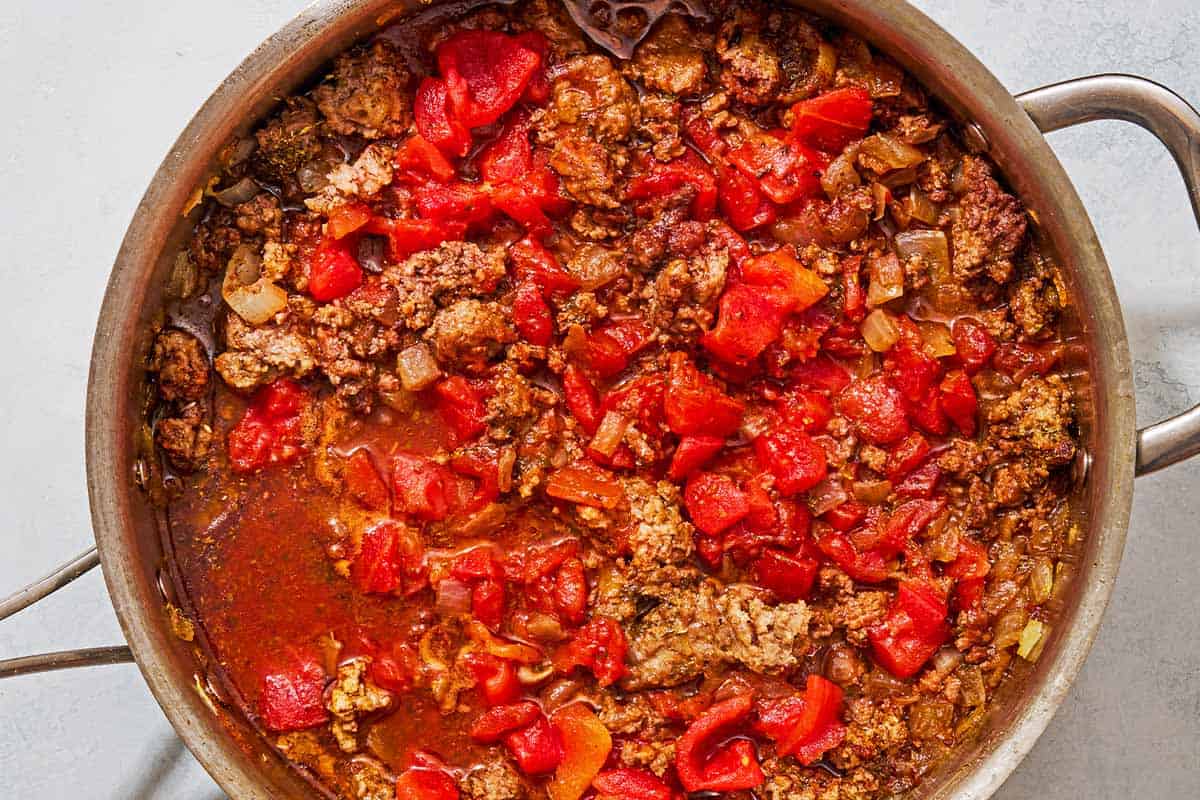
- Meanwhile, start the meat sauce. In a small saucepot, set over medium-low heat add 1/2 cup beef broth. In a separate large skillet set over medium heat, add 2 tablespoons olive oil. Once the oil begins to shimmer, add 1 finely chopped onion and stir regularly until it’s slightly golden brown, about 5 minutes. Now add 1 pound ground lamb or beef and toss regularly until fully browned. Pour off any excess fat, then return the skillet to medium heat.
- Season the meat sauce. Stir in 1 tablespoon dried oregano, 1 teaspoon cinnamon, and 1/2 teaspoon each black pepper, nutmeg, and paprika. Add 1/2 cup red wine and boil for 1 minute to reduce, then stir in 1 (14-ounce) can of diced tomatoes, 1 teaspoon sugar, and the hot broth. Simmer over medium-low heat until rich and fragrant, 20 to 30 minutes.
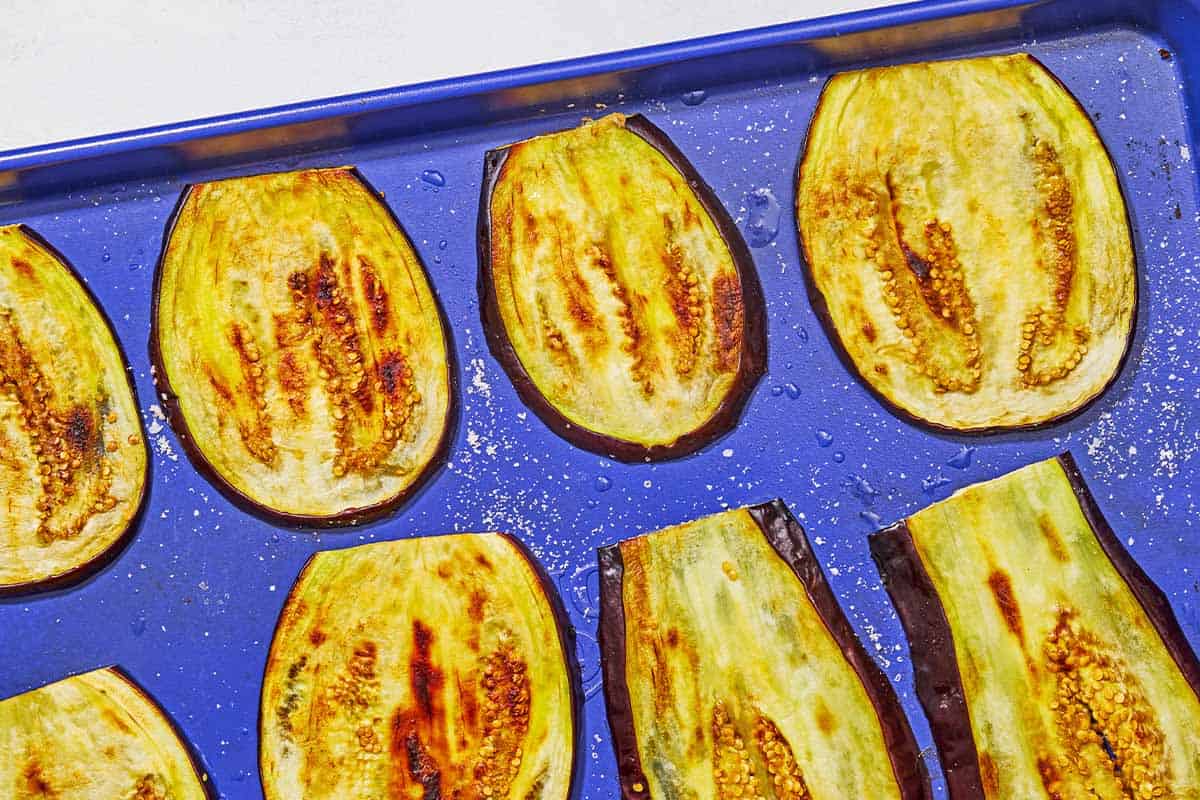
- While the meat sauce simmers, prepare the eggplant. Turn the broiler to high. Brush a large sheet pan with extra virgin olive oil. Pat the eggplant slices dry, removing excess salt, and assemble in one layer on the prepared pan. Work in batches or use 2 pans if necessary to avoid overlapping. Brush the eggplant generously with olive oil on both sides.
- Broil the eggplant. Place the sheet pan about 6 inches away from the broiler. Broil the eggplant briefly, turning over so that both sides are softened and golden brown. Don’t worry if parts of the eggplant are slightly charred, but watch carefully so it doesn’t burn. Remove from the oven and set aside.
- Get ready to bake. Turn off the broiler and preheat your oven to 350°F. Lightly oil a 9 x 13-inch oven-safe baking dish.
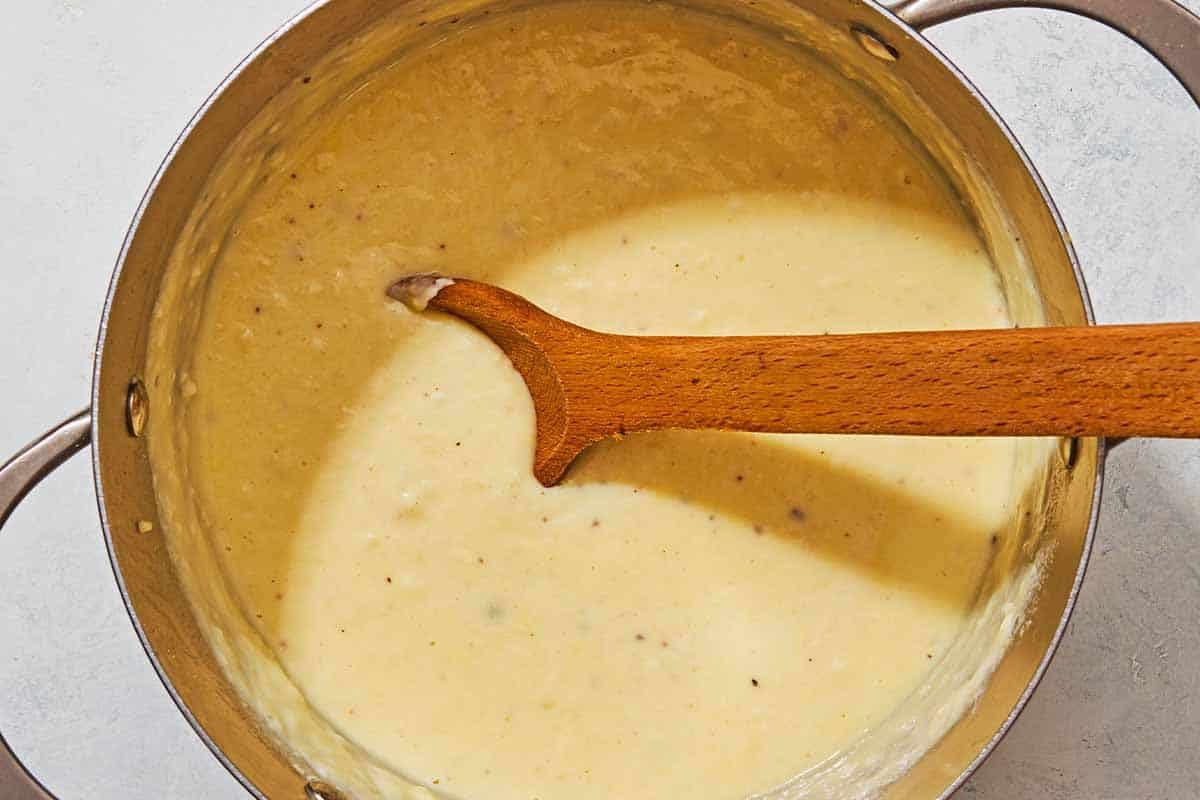
- Make the bechamel. In a small saucepot, set 4 cups of 2 percent milk over medium-low heat to warm. In a separate large saucepan, set over medium-high heat, add 1/3 cup + 2 tablespoons extra virgin olive oil. Once the oil begins to shimmer but not smoke. Stir 2/3 cup flour into the oil, along with 1/2 teaspoon salt and a pinch of black pepper. Stir continuously until golden (if needed, add a little more olive oil). Gradually add the warmed milk, whisking continuously. Continue to cook, stirring occasionally, over medium heat until thickened enough to coat the back of a wooden spoon, 5 to 7 minutes. Season with 1/4 teaspoon ground nutmeg.
- Finish the Greek bechamel. Add 2 eggs to a small bowl. Whisk in a ladleful of the hot bechamel mixture to temper the eggs, then slowly whisk the egg mixture back into the bechamel. Continue to stir or whisk the mixture, bringing it to a gentle boil for 2 more minutes. Taste and adjust the seasoning. Remove from the heat and allow to cool and thicken a little more. You should have a creamy, thick, and smooth bechamel sauce.
- Assemble the moussaka. Layer half the eggplant slices on the bottom. Add the meat sauce and spread well, then top with the remaining eggplant slices. Pour the bechamel on top and spread to cover all the eggplant, then sprinkle with 1/4 cup breadcrumbs.
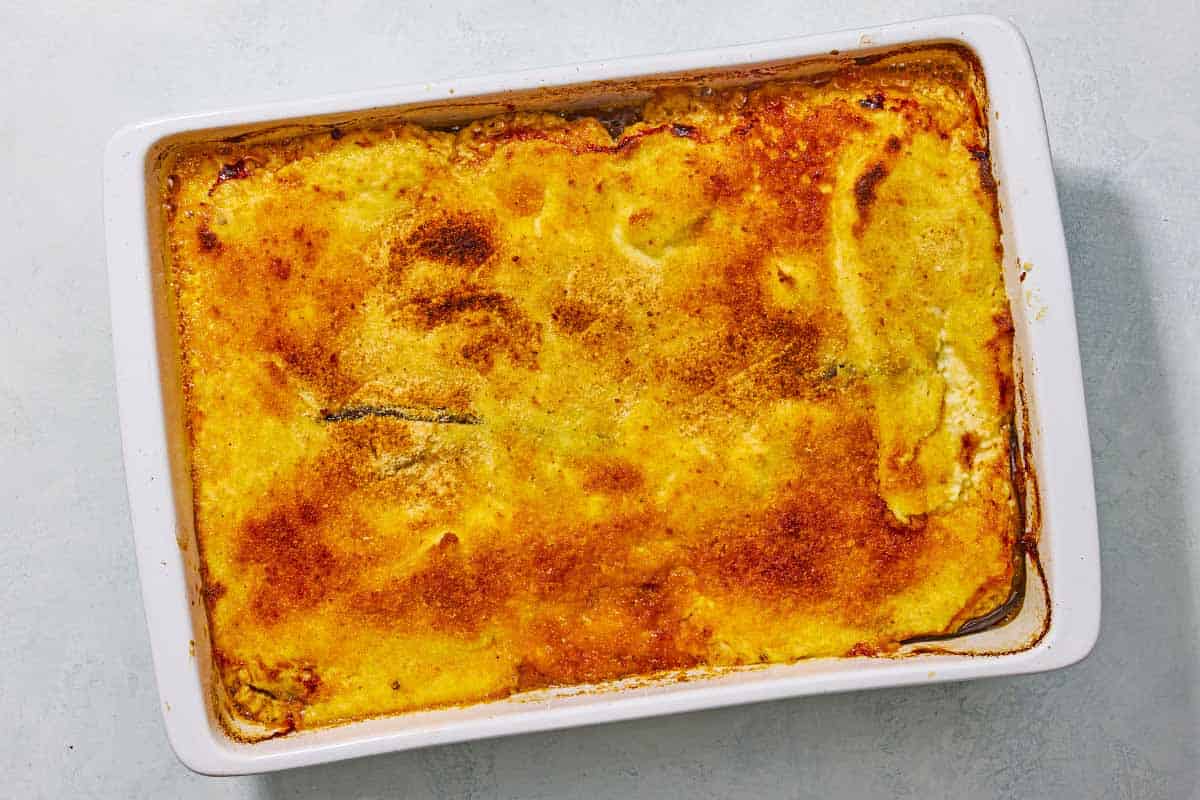
- Bake. Bake the moussaka casserole on the center rack of the heated oven for 45 minutes. If desired, transfer the baking pan to the top rack and broil briefly so the top of the moussaka gains a nice golden brown color (watch carefully).
- Slice and serve. Remove from the heat and let the casserole sit for 10 minutes. This will help it hold its shape. Slice into squares to serve. Enjoy!
Variations
Moussaka is a popular dish in Middle Eastern and North African countries and Greece. I grew up with Egyptian Moussaka, which skips the bechamel sauce from the Greek version. But you can also find vegetarian moussaka in many places, and it’s equally as filling as this moussaka recipe.
Moussaka recipes, in general, are very flexible. Here are a few ways to make this recipe your own.
- Use potatoes instead of eggplants in moussaka, or use them both! Opt for starchy potatoes like russet or Idaho and slice them into 1/4-inch rounds. Drizzle the potatoes with olive oil, season with salt, and bake at 350°F for 20 minutes or until tender.
- Swap the bread crumbs for gluten-free breadcrumbs and thicken the bechamel with equal amounts of gluten-free flour instead of flour
- Opt for butter instead of olive oil
- Use a higher-fat milk
How to Store, Freeze, and Reheat Moussaka
- To store: Moussaka will keep in an airtight container in the refrigerator for up to 5 days.
- To reheat: Remove from the fridge and place on the center rack of 350°F oven for 25 to 30 minutes.
- To freeze whole: Allow to cool completely before covering snugly with plastic wrap and then wrapping it in foil. Freeze for up to 3 months.
- To freeze Individual squares: Place each square in individual containers and freeze for up to 3 months.
- To reheat frozen moussaka, thaw slices in the fridge overnight before reheating at 350°F for about 25 to 30 minutes.
Perfect Pairings
This moussaka recipe is a complete meal, but if you want to balance the cozy comfort of this dish with something light and fresh, or finish with a dessert here are a few of my favorites:
- Make one of two famous Greek salads Horiatiki or Maroulosalata.
- For a full Greek feast, finish with baklava or melomakarona, a cookie scented with orange and cinnamon.

Ingredients
For the eggplant
- 2 large globe eggplants
- Kosher salt
- Extra virgin olive oil
- 1/4 cup breadcrumbs
For the meat sauce
- 1 large yellow onion, finely chopped
- 1 pound ground lamb or beef
- 1 tablespoon dried oregano
- 1 teaspoon ground cinnamon
- 1/2 teaspoon black pepper
- 1/2 teaspoon ground nutmeg
- 1/2 teaspoon paprika
- 1/2 cup red wine
- 1 (14 ounce) can diced tomatoes
- 1 teaspoon sugar
- 1/2 cup beef broth, warmed until simmering
For the bechamel
- 1/3 cup + 2 tablespoons extra virgin olive oil
- 2/3 cup all purpose flour
- 1/2 teaspoon salt, plus more to taste
- Black pepper, to taste
- 4 cups 2% milk, warmed
- 1/4 teaspoon ground nutmeg
- 2 large eggs
Instructions
- Prep the eggplant. Trim off the ends of the eggplant, then slice into 1/4-thick slabs. (Discard the outermost slices that are mostly skin.) Spread the eggplant in one layer and sprinkle with salt. Let set for 30 minutes to "sweat out" its bitterness.
- Meanwhile, start the meat sauce. Heat 2 tablespoons olive oil in a large skillet over medium heat. Add the onion and stir regularly until its slightly golden brown, about 5 minutes. Now add the ground lamb or beef and toss regularly until fully browned. Pour off any excess fat, then return the skillet to medium heat.
- Season the meat sauce. Stir in the dried oregano, cinnamon, pepper, nutmeg, paprika, and a big pinch of salt (about 1/2 teaspoon). Add the wine and boil for 1 minute to reduce, then stir in the canned tomatoes, sugar, and hot beef broth. Simmer over medium-low heat until rich and fragrant, 20 to 30 minutes.
- While the meat sauce simmers, get ready to broil the eggplant. Turn the broiler of your oven to high. Brush a large sheet pan with extra virgin olive oil. Pat the eggplant slices dry, removing excess salt, and assemble in one layer on the prepared pan (work in batches or use 2 pans if necessary to avoid overlapping.) Brush or coat the eggplant generously with olive oil on both sides.
- Broil the eggplant. Place the sheet pan about 6 inches away from the broiler. Broil the eggplant briefly, turning over so that both sides are softened and golden brown (do not worry if parts of the eggplant are slightly charred, but watch carefully so it doesn't burn). Remove from the oven and set aside.
- Get ready to bake. Turn off the broiler and preheat your oven to 350°F. Lightly oil a 9 1/2" x 13" oven-safe baking dish.
- Make the bechamel. In a large saucepan, heat the olive oil over medium-high heat until shimmering but not smoking. Stir in the flour, salt, and grind/pinch of black pepper. Cook, stirring continuously, until golden (if needed, added a little more olive oil). Gradually add the warmed milk, whisking continuously. Continue to cook, stirring occasionally, over medium heat until thickened enough to coat the back of a wooden spoon, 5 to 7 minutes. Season with the nutmeg.
- Finish the Greek bechamel. Add the eggs to a small bowl. Whisk in a ladleful of the hot bechamel mixture to temper, then slowly whisk the egg mixture back into the bechamel. Continue to stir or whisk the mixture bringing to a gentle boil for just 2 more minutes. Taste and adjust the seasoning. Remove from the heat and allow to cool and thicken a little more. You should have a creamy, thick and smooth bechamel sauce.
- Assemble the moussaka. Layer half the eggplant slices on the bottom. Add the meat sauce and spread well, then top with the remaining eggplant slices. Pour the bechamel on top and spread to cover all the eggplant, then sprinkle with the breadcrumbs.
- Bake. Bake the moussaka casserole on the center rack of the heated oven for 45 minutes. If desired, transfer the baking pan to the top rack and broil briefly so that the top of the moussaka gains a nice golden brown color (watch carefully).
- Slice and serve. Remove from the heat and let the casserole sit for 10 minutes (this will help it hold its shape and juices). Slice into squares to serve. Enjoy!
Video
Notes
- Shop this recipe: Visit our shop to browse quality Mediterranean ingredients, including the olive oil and spices used in this recipe.
- Make ahead tips: You can prepare and broil the eggplant and meat sauce a day or two in advance. The bechamel sauce can also be made a few days ahead (it can hold texture for about 1 week, although you should count some days for leftovers). Keep each component in the fridge in separate tightly-closed containers. If the bechamel thickens too much, you may need to reheat it gently before using over low heat, adding a little more milk and whisking to make sure the mixture isn’t lumpy.
- Storage: Cool completely, then cover with plastic wrap and store for 5 days in your refrigerator. Or, once it cools, simply cut the moussaka into pieces and freeze (you can store the pieces in separate freezer-safe containers or wrapped tightly with parchment then foil. This way, you can reheat individual slices at a time.)
- Potatoes? Yes, you can use potato instead of eggplant in moussaka, or use them both! Opt for starchy potatoes like russet or Idaho and slice into 1/4-inch rounds. Drizzle the potatoes with olive oil, season with salt, and bake at 350°F for 20 minutes or until tender.
Nutrition
Exotic 4-Pack
Bring the vibrant seasonings of the Mediterranean to your kitchen with Sumac, Aleppo pepper, Ras el Hanout, and Baharat.
*This post has been recently updated with new information for readers’ benefit.

Unfortunately, this didn’t work for me. Let it sit for 20 min, still fall apart liquid. Taste was really plain to me and I followed instructions exactly. Edible, but I would not make again
The Bechtel did have a weird texture, still edible, BUT where do the potatoes and zucchini come in at? Where do they belong in this recipe? The instructions do not mention them!
Hi, Pamela. Zucchini or potatoes can be used here in place of or in addition to the eggplant. If you want a bit more guidance on how to add potatoes and zucchini to moussaka, you can check out Suzy’s Vegetarian Moussaka recipe.
Was delicious. The only thing I would do differently is thicken the meat sauce.
Wanted so badly to love this. Unfortunately, we didn’t care for the bechamel sauce. It actually tasted great but it had such a strange texture… and didn’t seem to mix well with the other ingredients (none of us are usually sensitive to food textures). I did try to follow the recipe exactly, but this could totally come down to my error in making this for the first time. And since this took an incredibly long time to assemble, I probably won’t attempt again.
Thank you for the feedback. We appreciate you giving it a try!
I fell in love with Greek food after visiting Athens . These recipes are just what the doctor ordered ! Yeah 😎!
Love your stuff ❤️
Thanks so much, Braven!
I made this lovely dish but substituted cinnamon for nutmeg and it was delish!
Thank you for sharing!
Wonderful recipe. The family loved it, I loved it. Well worth the time it took to make. I’d never made moussaka before or used lamb mince, or had a bechamel made on oil instead of butter – and really enjoyed it.
Thank you Suzy.
Hi Suzy. Any suggestions on making this vegetarian ?
Thanks. Jeri
Hi, Jeri. We actually have a vegetarian moussaka recipe on the sight you can check out.
This was a lot of work but worth it! I used one eggplant and 3 potatoes, next time I am going to double the eggplant and potatoes. I am looking forward to eating the leftovers.
My husband had seconds.
This recipe is amazing. The only change I made was to substitute ground turkey for the lamb (I have one in the house that will only eat poultry). Even with turkey, it was so flavorful. I appreciated the tip on making sections of it ahead of time. I did the eggplant and the meat layer, then finished it a few days later. Came out great. This recipe, and your site, is a keeper!
I have not tried this recipe, but it looks delicious, and I’m sure I’ll be making it soon. What I really wanted to comment on is that you obviously know the Mediterranean is not just Greece and Italy, but all of north Africa! This is the part of the Mediterranean I’m interested in learning more about. I’ve read your recipe for shakshuka and I think the sauce alone would be great on bruchetta. But this is the side of the Med where you find that ginger, cinnamon, nutmeg are indeed Mediterranean spices, as well as harissa and za’ater. I’m looking forward to diving deeper into your website.
Thanks so much, Susan!
First time reader-delicious recipe which I followed as written using ground lamb. This was a trial run for a Mediterranean themed dinner that I’ll be hosting in February. Thank you for the clear instructions and video. I’m looking forward to trying more recipes from your site!
Awesome! Thanks, Jennifer!
I have a question.. you wrote hot paprika on the instructions but below you recommend sweet paprika.. did you mean to write hot? Or is it just your preference to use sweet? Just curious because I remember moussaka being on a slightly sweeter scaler versus hot. Thanks for your info!
Hi, Jess. We typically use the sweet, but the hot will work if that is something people prefer. Enjoy!
I ended up using 1/2 sweet Spanish paprika and 1/2 hot Hungarian paprika since I didn’t know. Came out great! It did take quite a bit of time to prep but I have a tiny food processor and hand to mandolin a potato by hand since I added an extra layer on the bottom. I added pecorino cheese to the bechamel.
The wine I used was Greek; 80% agiorgitiko/20% cabernet and paired it with it. Today I’m drinking it with a Nobile from Montepulciano.. great pairings!
The only thing I need to do next time is use a bigger pan. The one I used was just slightly too small so there was too much bechamel but I figured it would be better than using one slightly too big. So I just didn’t eat all the bechamel… so on the search for a glass pan in between 😀
Thank you for the recipe! Oh I also used both sea salt and Himalayan salt plus black zanzibar pepper and white pepper on both parts of the recipe and used Greek oregano.. delicious! But it did take me about 2.5-3 hours total with prep because I had to do batches of things and I didn’t have a lot space and the mandolin I have is flimsy plus I added potatoes.. that being said, it was well worth it! Efcharisto poly!
Next time I’ll try with just sweet paprika but I like the lingering heat on the palate the Hungarian pepper leaves.
We traveled to Greece this past fall and enjoyed the food so much. Several of your recipes call for nutmeg. My hubby refuses to use it as he insists that nutmeg is not a Greek spice. Can you give me a good argument to convince him that we should use it in this dish? Thanks!
Made this last night and it was absolutely delicious!
I have not tried this version of the recipe but the previous version was one of my families absolute favorites. Are you able to repost the old version (per page as an alternate) or email the original?
The original was the best! I liked it because it was a lighter, healthier version. I know it’s late notice, but I wrote down the recipe luckily. Instead of the bechemal, the topping was 3/4c Greek yogurt, 3 eggs(beaten, 1 Tbsp AP Flour, 1/2c Ricotta, and 3oz Feta Cheese (crumbled) whisk it all together and pour it over the potato layers, followed by bread crumbs. She used all low fat options but up to you.
I also add a lot more seasoning then the recipe and use a blend of smoked and sweet paprika. Hope this helps!