
Salsa brava, also known as brava sauce, is a smoky, spicy, paprika-forward tomato sauce drizzled over a Spanish potato tapa called patatas bravas. It’s easy to make at home, and can dress up more than fried spuds!
What is Bravas Sauce?
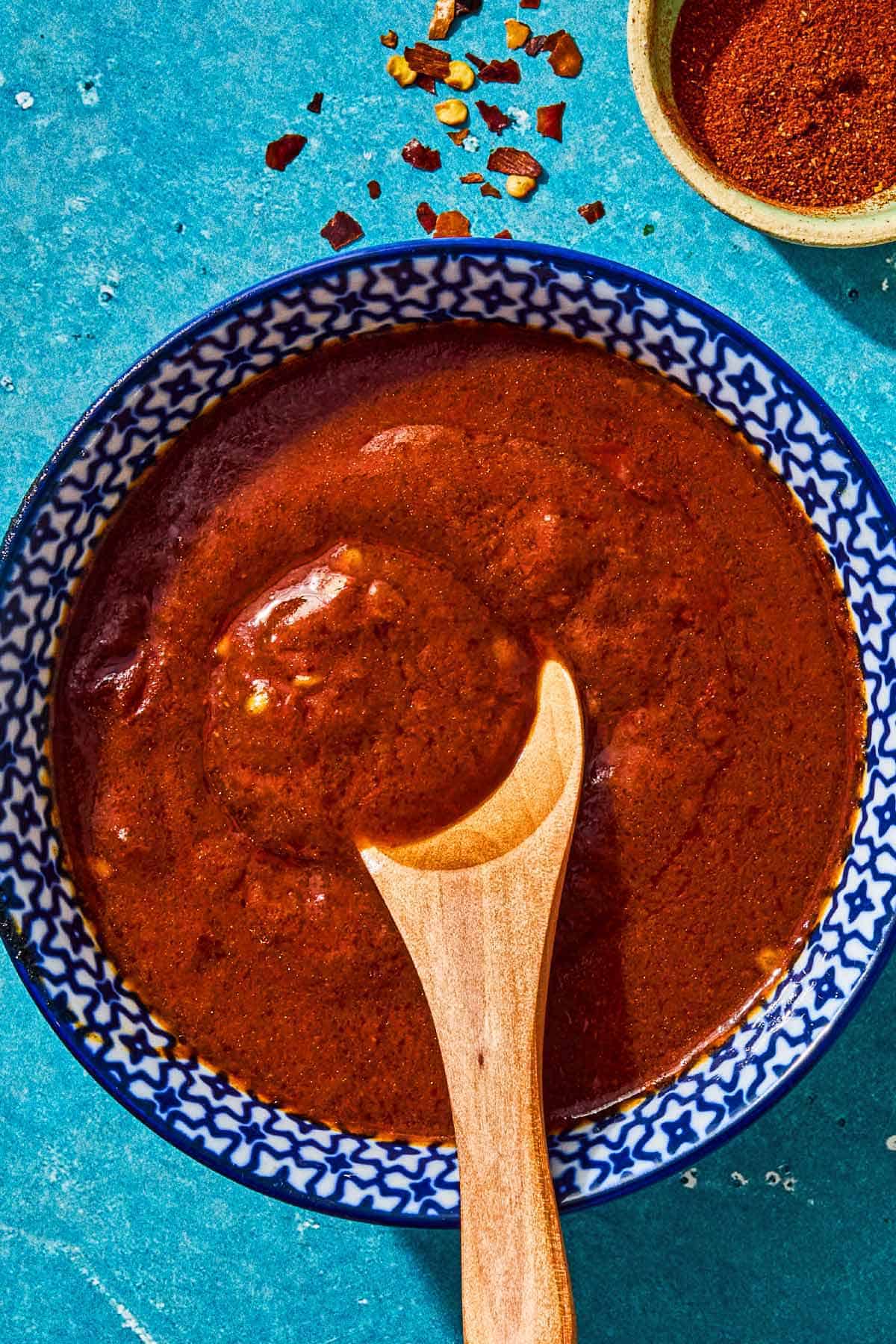
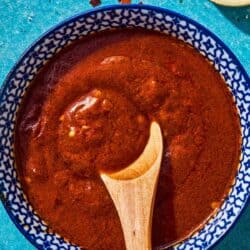
Bravas sauce (or salsa brava) is a spicy condiment from Madrid, Spain. It is typically used with the popular tapa patatas bravas, which is found in tapas bars throughout the country. The sauce is bold, slightly spicy, garlicky, and smoky, thanks to a generous amount of smoked paprika.
And while bravas sauce is traditionally served over crispy fried potatoes, you can drizzle this piquant condiment as a finishing sauce on chicken or fish, mix it into aioli for a spicy garlic dip or sandwich spread, use it to accompany fried calamari, or drizzle over other well-loved tapas like Spanish tortilla or padrón peppers.
To be clear, bravas sauce is not that spicy. But what gives it a bit of a kick and a deep smoky flavor is pimentón, which is smoked Spanish paprika.
Trust me, once you try it, you will find many ways to use this versatile sauce.
Salsa Brava Ingredients
Tomatoes are a point of contention in bravas sauce recipes. Some claim the sauce should contain tomatoes. Others say tomatoes have no place in the sauce and that smoked paprika alone should give the sauce its color. For this recipe, I used a little tomato paste to improve sauce consistency, color, and umami.
- Extra virgin olive oil: Since this is a Spanish recipe, I opted for our Hojiblanca Spanish Extra Virgin Olive Oil. This fruity, bitter, slightly peppery oil works well in this recipe.
- Garlic cloves: Slice up some garlic to cook in the olive oil and infuse it with garlicky flavor. You’ll need to remove the garlic once it’s cooked, which is why we slice, rather than mince it.
- Tomato paste: While absent from some salsa brava recipes, you’ll find tomato in most modern iterations of the sauce. Tomato paste not only adds vibrant color to the sauce, but it also adds some acidity and umami.
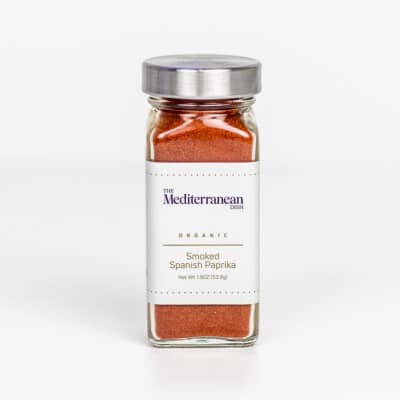
- Smoked paprika is the main flavor-maker. It provides depth and a subtle heat. I use our Smoked Spanish Paprika in this recipe, since most of the heat comes from red pepper flakes.
- Crushed pepper flakes: I used a teaspoon of red pepper flakes, but you can use more or less depending on your preference.
- Cornstarch is a thickening agent, and it’s responsible for the drizzly-but-not-runny consistency of the sauce.
- Vegetable broth: Use store-bought or homemade vegetable broth, and whisk continuously to incorporate, which will give you a delightfully smooth sauce.
- Sherry vinegar or red wine vinegar: Vinegar adds acidity that instantly brightens the sauce. I used red wine vinegar.
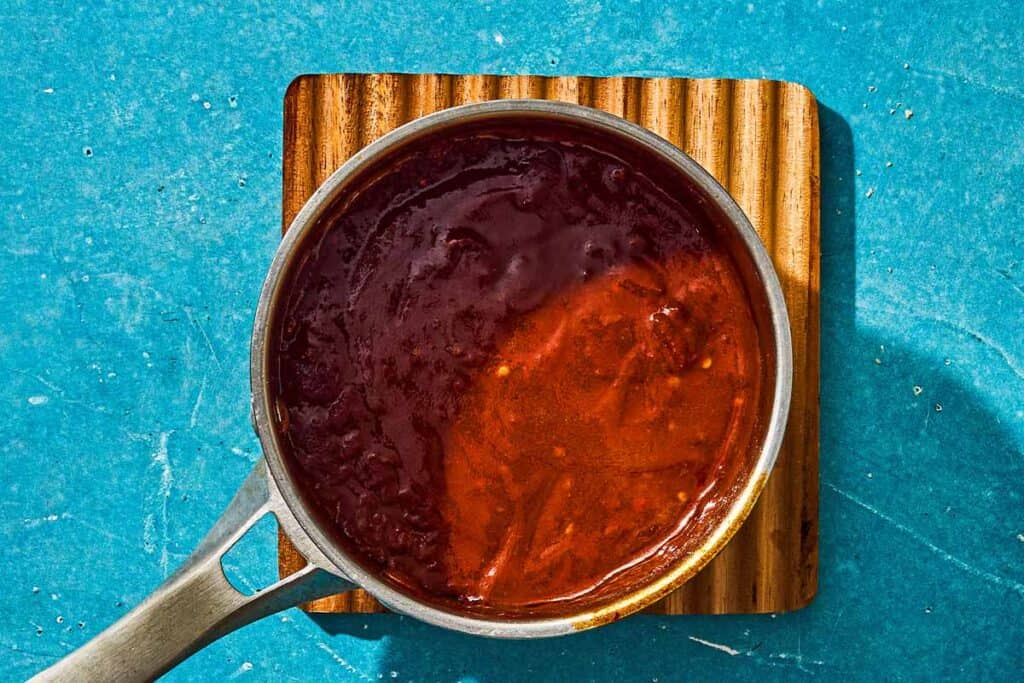
How to Make Bravas Sauce
Minimal prep is required to make this flavorful sauce! Bravas sauce should also be a smooth sauce: no chunks of garlic; rather, it should be uniform, with body, but thin enough to drizzle.
- Heat the olive oil and cook the garlic. Set a medium saucepan over medium heat, and add 1/4 cup extra virgin olive oil and 2 cloves of sliced garlic. Toss until the garlic is golden and the oil starts to shimmer. Make sure the garlic does not brown; you want to infuse the oil with flavor. This will only take a couple of minutes. Use a slotted spoon to remove the garlic and discard.
- Make the sauce. Lower the heat and add 1 tablespoon tomato paste, 2 teaspoons smoked paprika, 1 teaspoon crushed red pepper flakes, and 1 tablespoon cornstarch. Whisk to combine, then slowly whisk in 1 cup vegetable broth until it’s incorporated. As you continue to whisk, you’ll notice the sauce becomes smooth and velvety. Cook for 10 minutes or so, watching for it to thicken a bit as you whisk, then add 1/2 to 1 teaspoon red wine vinegar. Whisk again and remove from the heat.
- Store. If you’re making patatas bravas, drizzle the salsa brava over the potatoes. If not, transfer the sauce to a mason jar. Let the sauce cool down before refrigerating.

Tips for the Best Salsa Brava
Keep these tips in mind to make the perfect bravas sauce recipe:
- Remove the cooked garlic from the oil to keep the sauce smooth. There shouldn’t be chunks of garlic in this sauce, which is a mistake many bravas sauce recipes make. Once you cook the garlic enough so the oil is infused with flavor, remove the garlic slices from the oil.
- Whisk regularly to ensure perfect consistency. Whisking the ingredients helps to incorporate the cornstarch well so that the sauce thickens.
- Do not use too much cornstarch to thicken the sauce. About 1 tablespoon of cornstarch (2 tablespoons at most) will give you a velvety, perfectly thick salsa brava. The sauce will continue to thicken as it sits. Too much cornstarch will give you a goopy mixture that you won’t be able to drizzle.
- Control the spice level by using smoked paprika and a dash of red pepper flakes. Bravas sauce is not meant to be fiery hot. If you haven’t made it before, use smoked paprika and a teaspoon or so of red pepper flakes to start. For more heat, add more, or combine it with some of our Hot Smoked Paprika.
How to Use Bravas Sauce
In addition to patatas bravas, you can use this recipe to add a smoky, rich element to many recipes:
- Make a dip or spread: Mix it with mayo, aioli, yogurt, or sour cream to dip veggies, fried calamari, fries, or spread on your favorite sandwich recipe.
- Drizzle it over or serve it alongside chicken skewers or pan-seared salmon. You can also use it over veggies like my sautéed cabbage.
- Don’t forget breakfast: Spoon it over Spanish Migas or your favorite scrambled eggs.
How to Store, Reheat, and Freeze
- Store: Bravas sauce will keep for up to 4 days in a tightly sealed jar in the refrigerator. It will thicken as it sits, so you may need to thin it out with a little broth or water when you reheat it.
- To Reheat this sauce, pour it into a pan set over medium heat and whisk in broth or water (1 tablespoon at a time) until you reach the right consistency.
- To freeze salsa brava, transfer the completely cooled sauce to a freezer-safe container and freeze for up to 3 months. Defrost overnight in the fridge, before reheating it the same way I explained above.
More Mediterranean Sauce Recipes
Spanish
5-Minute Romesco Sauce
Dips and Condiments
Tonnato—The Italian Tuna and Caper Sauce You’ll Want on Everything
Moroccan and Tunisian
5-Minute Chermoula Recipe

Ingredients
- 1/4 cup Extra virgin olive oil
- 2 garlic cloves, sliced
- 1 tablespoon tomato paste
- 2 teaspoons smoked paprika
- 1 teaspoon crushed pepper flakes, more or less to your liking
- 1 tablespoon cornstarch
- 1 cup vegetable broth
- 1/2 to 1 teaspoon red wine vinegar or sherry vinegar
Instructions
- Infuse the oil. Set a medium skillet over medium heat and add the extra virgin olive oil and sliced garlic. Cook, stirring until the garlic has turned golden and the oil is shimmering, this should only take a couple of minutes.
- Discard garlic. Remove the garlic from the pan and discard or keep for other uses.
- Finish the sauce. Lower the heat and add the tomato paste, smoked paprika, red pepper flakes, and cornstarch; whisk to combine. Slowly add the vegetable broth, and whisk until the broth is incorporated and the sauce has a smooth, velvety consistency. Add 1/2 to 1 teaspoon red wine vinegar, whisk again, and remove from the heat.
- Serve. Transfer to a serving bowl, drizzle over your patatas bravas store for another use. Allow the sauce to cool before transferring to the fridge.
Notes
- This sauce is meant to have body but still be able to drizzle. It will thicken as it sits. If it is too runny as you are finishing it, you can add a little more cornstarch, but be careful, as it can get too thick.
- For a less spicy option, use fewer red pepper flakes. For more heat, use more or add some hot smoked paprika.
- How to use bravas sauce: Use salsa brava on patatas bravas. But I like to use it on pan-seared salmon or sautéed cabbage as well! See my post for more ideas.
- How to store and reheat salsa brava: Store the sauce in a jar for up to 4 days. To reheat, transfer it to a pan and reheat over medium heat. It will have thickened in the fridge, so feel free to whisk in some water or broth (1 tablespoon at a time) until you reach the consistency you want.
- Shop this recipe: Visit our shop to browse quality Mediterranean ingredients, including the olive oil and spices used in this recipe.
Nutrition
Try our Smoked Spanish Paprika
Take your Spanish dishes to a whole new level with this bold and smoky spice! So much flavor and a subtle heat you’ll love.

Can I use flour if I don’t have cornstarch and if yes, how much flour?
I’m sorry, but I would not compromise a perfectly good batch of fried potatoes with this sauce. It was thin and the taste was unappealing. Every salsa brava recipe is different, but this wasn’t like any salsa brava I’ve had before.
I’m not sure how you could get this simple recipe wrong. Followed it exactly and it turned out as expected. I did cook a touch longer to have it reduce a little but otherwise bang on. Can’t wait to try it on the patatas!
I cannot understand some of the more recent comments on this recipe. Maybe people can’t read, or maybe they don’t have the patience to follow the instructions correctly. This sauce is beautiful. I made it a touch spicier by adding some extra cayenne pepper, and the result was fantastic. Will definitely be making this again.
I think the measurements of ingredients listed mst be off, or maybe there’s an ingredient missing? Very watery – Should it be a can of tomato paste instead of a tablespoon? Other recipes for this have very different proportions of ingredients.
Hi Kevin. I’m sorry this turned out a little watery for you. Next time I recommend using less of the broth.
Can this sauce be water bath canned?
I’m so sorry, Chancy, but we’re not familiar with water bath canning. Hopefully another reader can share some insights here.
Tasted awful and came out a very different color and consistency than the photo.
Hey Matt.
I find that if you reduce the heat a bit it comes out really good all the time (my experience). It is important that you don’t burn the garlic, and also don’t burn the cornstarch/tomato paste roux. Low and slow…always works when making a roux!
I hope this helps, it really is a wonderful Bravas sauce.
Respect!
Jeff in Houston
(Not an employee, just a follower for years)
Made it twice and it turned out terrible both times. Followed the recipe perfectly and it was so bad can’t even use it and it looks nothing like the picture.
hey Alex,
Please read my comment above (to Matt). You might find the suggestions useful. Making a roux for a sauce can be difficult when adding tomato paste, and it needs to make on a lower heat than you might be used to when making a sauce roux.
I hope this helps!
Respect!
Jeff in Houston
I made this following the instructions exactly and it came out incredibly thin and watery, not at all as pictured.
Hey Kate,
I have made this many times and it comes out perfectly when I make a double batch. Remember, it will thicken as it cools. You could also (with a double batch) make an additional corn starch slurry with a bit of the broth and another 1/2 tablespoon of corn starch (my experience).
I hope this helps!
Respect!
Jeff in Houston