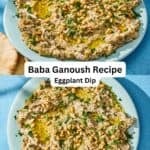
Baba Ganoush Recipe

This post may contain affiliate links. Please read our disclosure policy.
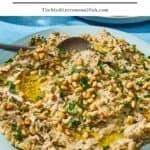
Creamy, savory, smoky eggplant dip with tahini, garlic, and citrus, my family’s authentic baba ganoush recipe is a must-try!
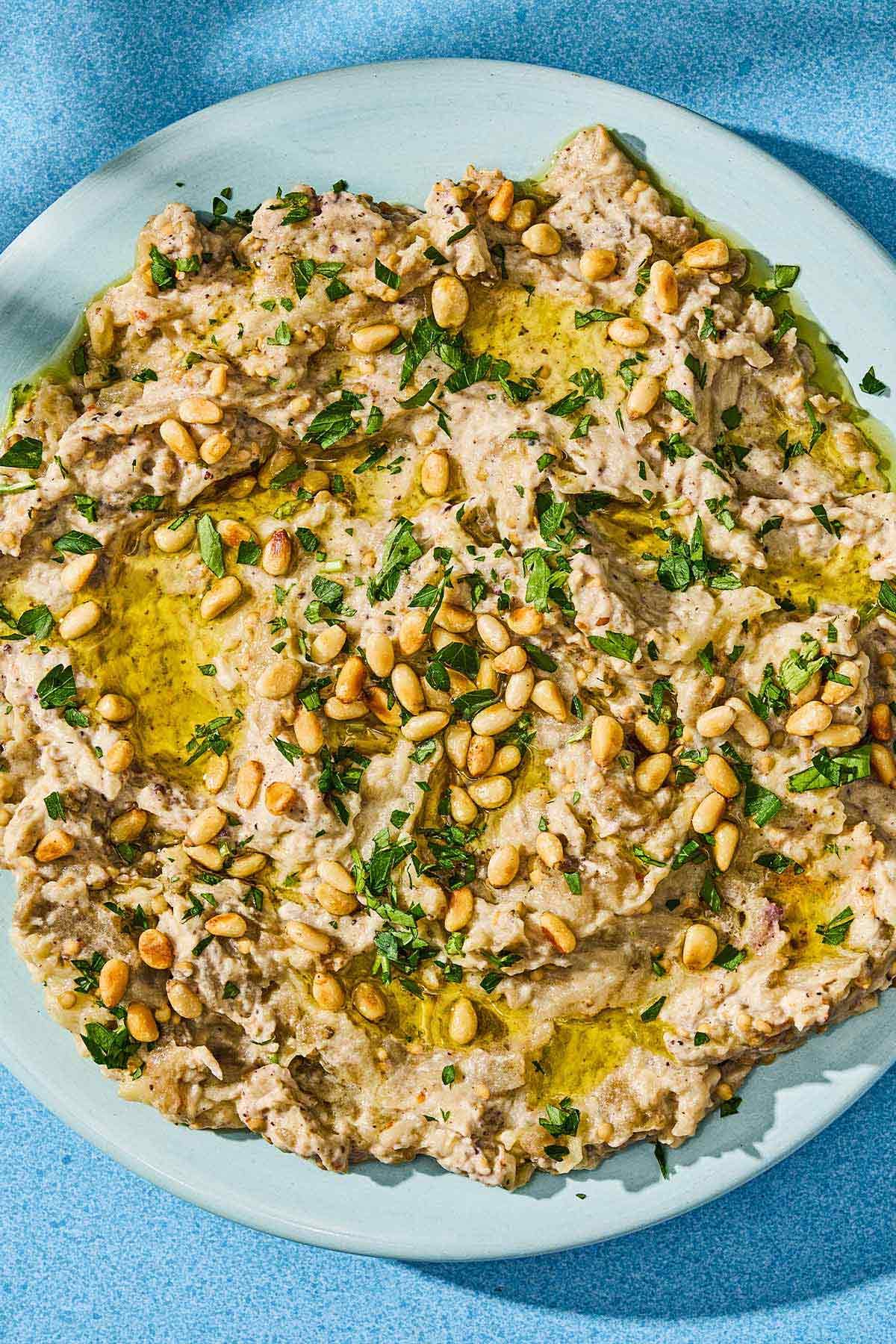
My Family’s Baba Ganoush Recipe
Growing up in Egypt, I ate baba ganoush regularly, and I’m happy to share my family’s recipe (and a few secret family tips) that have made this eggplant dip a favorite among my loved ones for generations.
Baba ganoush—also known as baba ganouj, muttabal, or salat hatzilim—is a smoky, rich, and creamy eggplant dip, traditionally made by mixing tender roasted (or charred) eggplant and nutty tahini with garlic, citrus, and spices.
It’s commonly served throughout the Eastern Mediterranean, including in Egypt, where I grew up, and the Levant region where my husband’s family is from. We both have strong opinions on what makes the best baba ganoush recipe. Because this smoky eggplant dip has traveled across borders, you can find endless variations. Some use tahini, as I do in my family recipe, but others leave it out and opt for different spice combinations.
The literal meaning of baba ganoush or baba ganouj is “spoiled dad,” referring to the fact that when you eat it, you just can’t help but feel a bit spoiled! There is a reason the French call it caviar d’aubergines, it is that delectable!
Luckily, this eggplant dip is easy to make at home, and it will keep in the fridge for up to a week. Once you try it, I’m sure your family will love it as much as mine does.
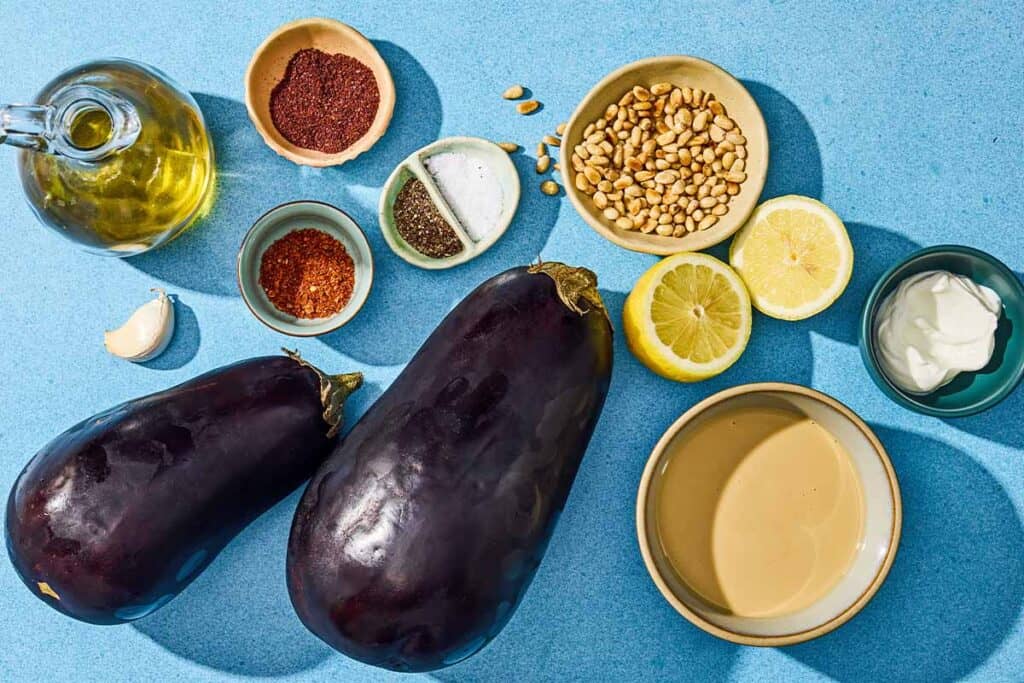
Baba Ganoush Ingredients
Let’s walk through the simple ingredients you need to make it:
- Eggplant: I use 2 smaller eggplants. Italian eggplant or the smallest globe eggplant you can find, works best; they will have fewer seeds, and the flesh is tender and not bitter.
- Tahini paste is made of toasted sesame seeds. I use Soom tahini made of 100% roasted and pressed organic Ethiopian White Humera sesame seeds, offering a creamy texture and a nutty flavor.
- Garlic: 1 to 2 fresh garlic cloves, depending on how garlicky you enjoy your dips.
- Lemon juice: Citrus gives this eggplant dip a nice lift. You can make it as subtle or lemony as you like.
- Greek Yogurt (secret optional ingredient): If you’re going for a vegan baba ganoush, omit the yogurt, but otherwise it is a great way to thicken the dip, making it even more creamy, while also enhancing the color, turning it from a deep beige to something a little brighter and more appealing.
- Seasonings: Salt and pepper, of course. If you like, add a bit of Sumac or cayenne pepper for heat.
- Extra virgin olive oil: A drizzle of a rich and peppery extra virgin olive oil over this dip is the perfect way to finish it!
- Garnish: I like to add toasted pine nuts and some chopped fresh parsley to serve, but it’s optional and totally up to you.
How to Make Baba Ganoush
Baba ganoush is easier to make than you think. You’ll start by cooking the eggplant (either by grilling over open flame or baking it in the oven), and then mix it with the remaining ingredients to make a delicious dip! Here is how:
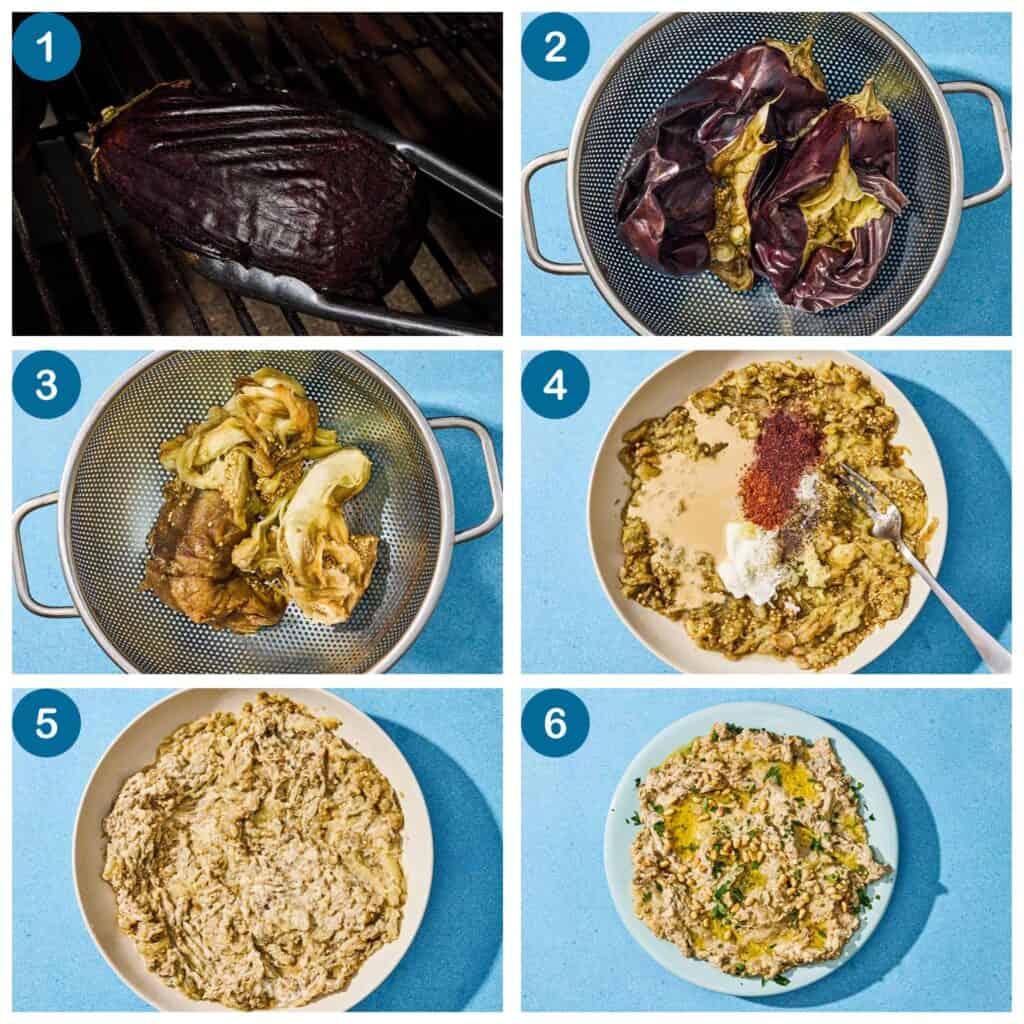
- Grill or bake the eggplant. Grill the eggplant whole over an open flame over medium-high heat. (I used my gas burner, but you can cook it on the grill), turning occasionally, with a pair of tongs, until the eggplant has fully charred on the outside and the flesh has collapsed and softened (about 15 to 20 minutes).
Alternatively, you can roast the eggplant in a high-heat oven. In this case, cut the eggplant in half and place it flesh-side down on a large lightly-oiled baking sheet and roast at 425°F for about 40 minutes or until the eggplant is very soft and cooked through. - Cool and Drain Well. Put the cooked eggplant in a colander. Use a knife to open it up a bit to allow it to cool quickly and drain its juices. Push down on the eggplant with the back of the spoon to drain excess liquid.
- Peel off the skin. When cool enough to handle, peel the charred skin off the eggplant and the stem and discard (Note: if you baked the eggplant, simply scoop out the flesh with a spoon.)
- Gently mix the eggplant with the tahini and remaining ingredients. At this point, make sure your eggplant is fully cooled and rid of excess water, then transfer it to a large bowl. Add 1/4 cup of tahini, minced garlic, fresh lemon juice, and the optional secret ingredient, 1 tablespoon of Greek yogurt. Season with a big pinch of kosher salt, and if you like, a little sumac and Aleppo pepper or red pepper flakes, if you like heat. Using a wooden spoon, mix gently to combine.
- Chill. If you have the time, cover the baba ganoush and chill it in the fridge for 30 to 60 minutes.
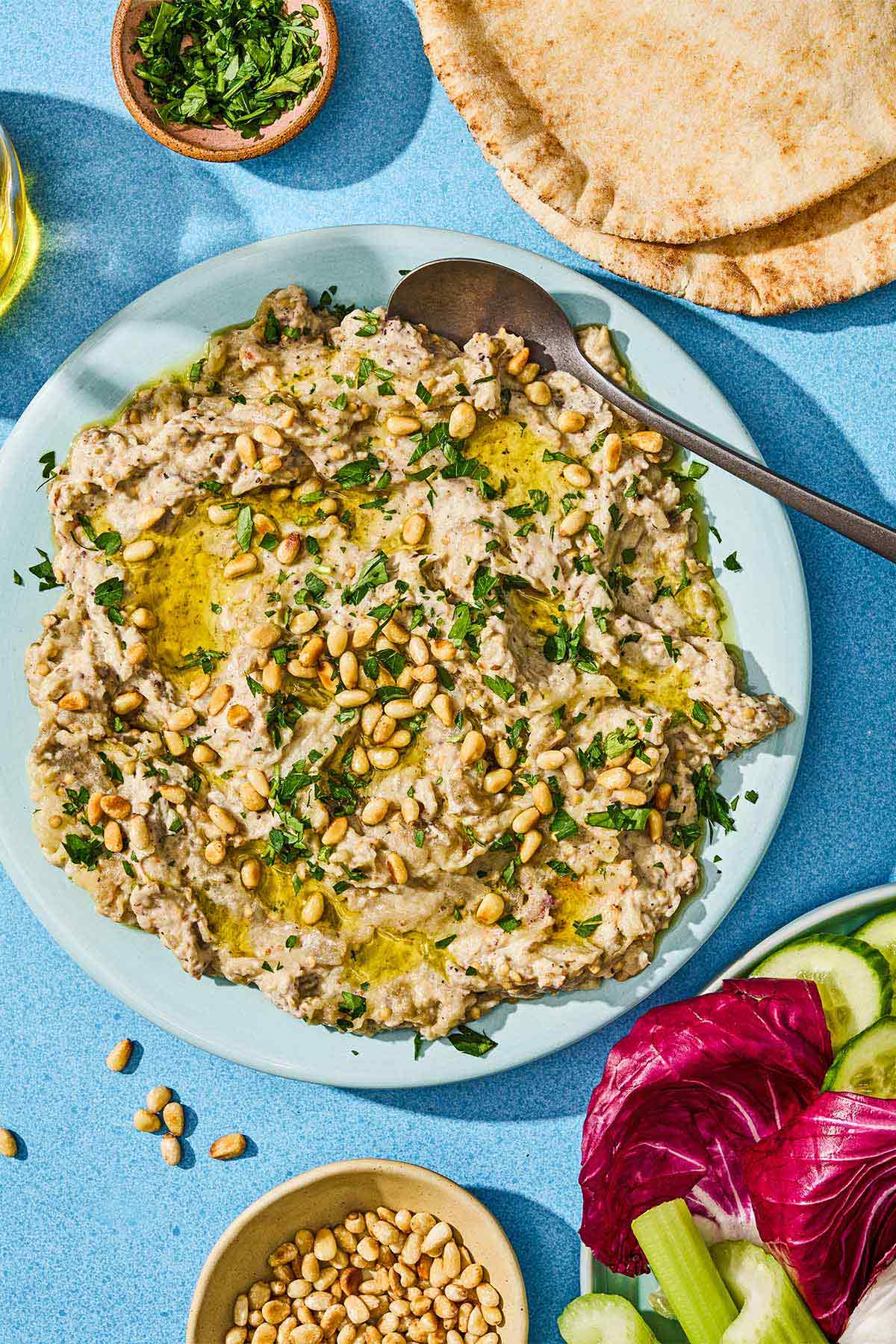
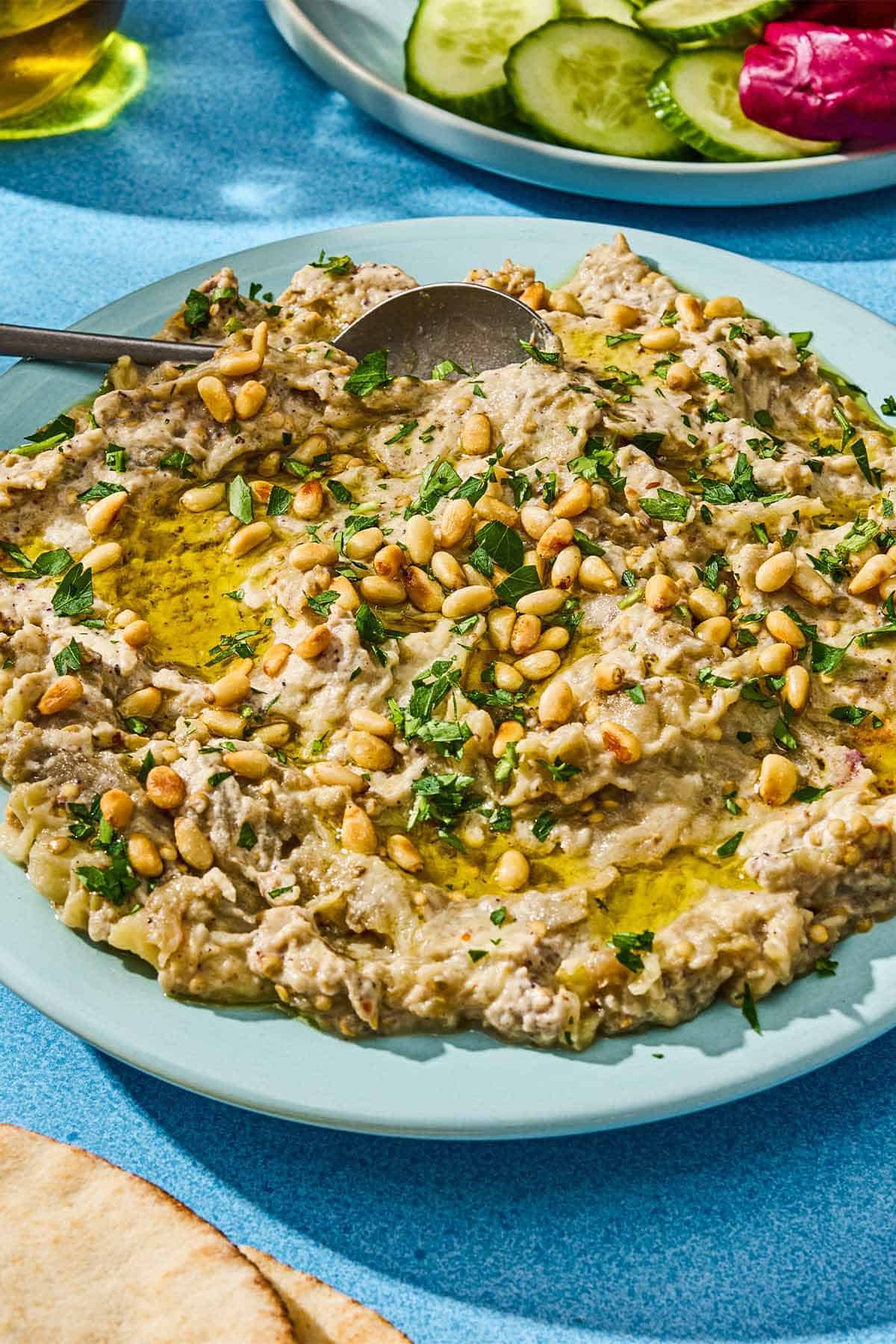
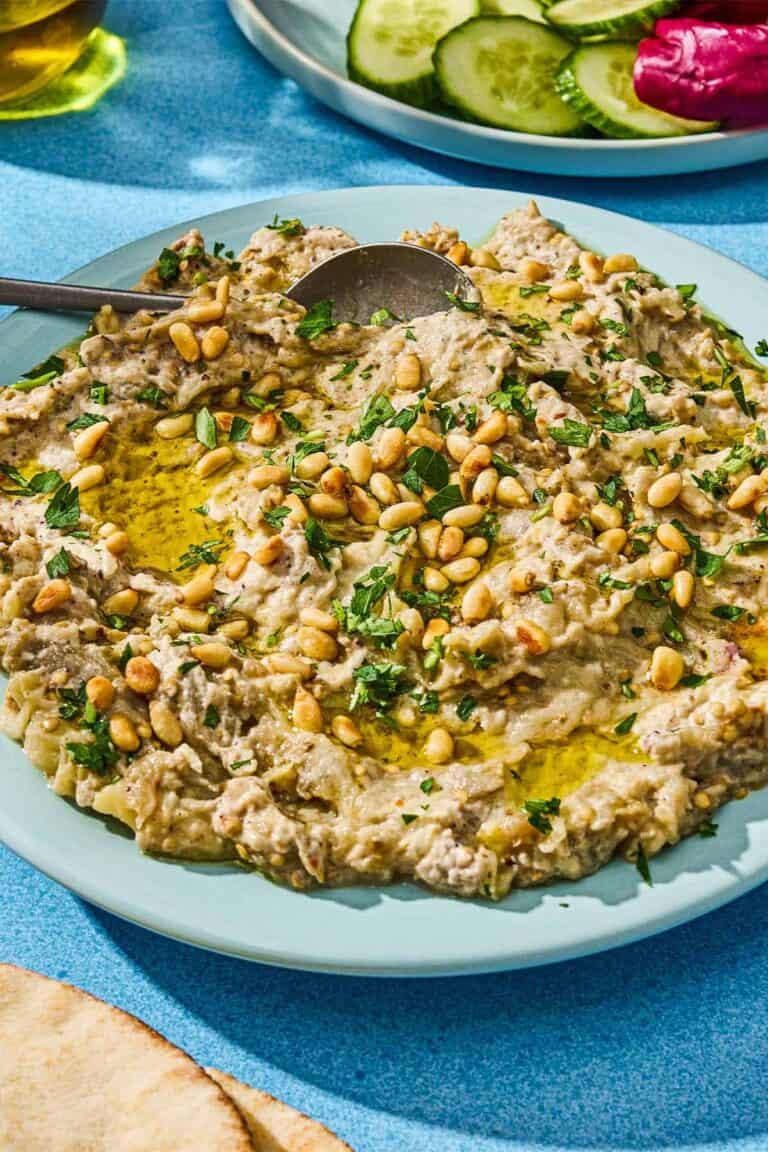
- Serve. Spread the baba ganoush on a rimmed serving plate or bowl and drizzle with extra virgin olive oil. Finish with toasted pine nuts and minced fresh parsley.
5 Pro Tips for the Best Baba Ganoush
- For the smokiest flavor, grill your eggplant (whole) over open flame until fully charred on all sides. You can always roast the eggplant in the oven if you don’t have a grill. But if you have access to a gas burner, that is the best way to get the smokiest eggplant dip! (Tip: cover up around the burner with some foil like I do in the video; it can get messy)
- Don’t skip the draining step; no one likes watery baba ganoush!
- Do not use a food processor or a blender. Instead, stir gently using a wooden spoon. This eggplant dip is meant to be creamy and rustic with some texture; it is not meant to be extra smooth. If you really want to use a food processor, only pulse a few times to combine so it doesn’t turn watery.
- Chill for 30 to 60 minutes to allow the flavors to meld and the dip to thicken.
- For vegan Baba Ganoush, omit the Greek yogurt. I use a little bit, and I think it helps the consistency and texture, but you can leave it out.
Is Baba Ganoush Healthy?
Although it tastes super rich, creamy, and delightfully indulgent, you can see from the list of ingredients that it is a healthy option. The main ingredient here is eggplant, which is a great source of vitamin B, vitamin E, fiber, and antioxidants. Plus, we have things like garlic, citrus, and tahini, which are also rich in nutrients. Baba ganoush is Mediterranean diet-friendly, vegetarian, vegan (if you don’t use the yogurt), and fairly low in carbs.
What’s the Difference Between Hummus and Baba Ganoush?
Both are popular, delicious dips throughout the Mediterranean and the Middle East. But they are two very different dips. Hummus is made with chickpeas, while the star ingredient in baba ganoush is eggplant.
The preparation method is also different. Hummus is meant to be silky smooth, and it is prepared in a food processor (see how to make hummus). In traditional recipes, we even peel the chickpeas! Baba ganoush is a rustic dip prepared by gently mixing the cooked eggplants with the rest of the ingredients using a wooden spoon or fork. A food processor is not recommended for making this eggplant dip because the texture can easily become runny.
What to Serve with Baba Ganoush
Obviously, I’m a big fan of serving baba ganoush the traditional way with pita bread to scoop up the dip. But you can use baba ganoush in different ways:
- As a spread. Just smear a bit of baba ganoush on sandwich bread. It will add so much more dimension and flavor to an ordinary sandwich!
- As part of a larger mezze platter
- As a side to grilled lamb chops or chicken kabobs
- To create the perfect dinner bowl! Add baba ganoush next to your favorite protein and a side salad for the perfect dinner bowl, as I did in these chicken shawarma bowls.
More Mediterranean Dip Recipes
Having grown up along the Mediterranean Sea, I can tell you one thing for certain: people of the Mediterranean love their dips! And really, what better way to kick-start your dinner than a creamy, smoky dip and some homemade pita to go with it?!
- Hummus
- Muhammara (Middle Eastern Roasted Red Pepper Dip)
- Tzatziki
- Haydari (Turkish Yogurt Dip with Garlic and Herbs)
Baba Ganoush Recipe

Ingredients
- 2 Italian eggplants or small globe eggplants
- 1/4 cup tahini paste I used Soom tahini
- 1 lemon, juice of
- 1 garlic clove, minced
- 1 tablespoon plain Greek yogurt, optional
- Kosher salt and black pepper
- 1 teaspoon sumac
- 3/4 teaspoon Aleppo pepper or red pepper flakes, optional
- Extra virgin olive oil
- Toasted pine nuts for garnish, optional
- fresh minced parsley for garnish, optional
Instructions
- Smoke or grill the eggplant. Turn one gas burner on medium-high. Place the eggplant directly over the flame. Using a pair of tongs, turn the eggplant every 5 minutes or so until it is tender and the skin is charred and crispy on all sides (20 minutes.) The eggplant should deflate and become super tender. If you don't have a gas burner, you can use a grill. You can also roast the eggplant in the oven (see notes).
- Drain and cool. Remove the eggplant from the heat and transfer it to a large colander over a bowl. Cut a slit in the eggplant to help it drain excess liquid and cool more quickly. Allow it to sit for a few minutes until fully cooled and all excess water has been drained. Push on it with a knife or a spoon to help release its juices.
- Peel the skin. Once the eggplant is cool enough to touch, peel the charred, crispy skin off (it should come right off). Discard the skin and the stem. Don't worry if a few bits of the skin remain; that's just added flavor!
- Make the dip. Transfer the cooked and fully drained eggplant to a bowl. Use a fork to break it down into smaller pieces. Add the tahini paste, garlic, lemon juice, Greek yogurt (if using), salt, pepper, sumac, Aleppo pepper, or crushed red pepper flakes. Mix gently with a wooden spoon or a fork until well-combined.
- Chill. Cover the baba ganoush and chill in the fridge for 30 minutes to an hour.
- Serve. Transfer the baba ganoush to a rimmed serving dish or a bowl. Top with a good drizzle of extra virgin olive oil, toasted pine nuts, and minced parsley, if you like. Serve with pita wedges or pita chips and veggies of your choice!
Recipe Notes
- To roast the eggplant in the oven instead: heat the oven to 425°F. Trim the eggplants and cut them in half, then salt it and allow it to “sweat out” excess water for about 30 minutes or so. Wipe it off, and arrange the eggplant on a lightly oiled baking sheet, flesh side down. Roast for about 40 minutes or until very tender and cooked through. Allow the eggplant time to cool a bit, then, using a spoon, scoop out the flesh and place it in a bowl. Follow the recipe from step #4.
- For best texture, mix the eggplant as directed using a wooden spoon or a fork rather than a food processor. This dip is meant to be creamy but on the rustic side with some texture.
- Store leftovers in a tightly closed container in the fridge for up to a week.
- Shop this recipe: Visit our shop to browse quality Mediterranean ingredients, including the olive oil and spices used in this recipe.
Nutrition
Nutrition information is automatically calculated, so should only be used as an approximation.
Shop Suzy’s curated selection of Mediterranean olive oils, spices, and more.
Bundle and Save!
Four of our best-selling signature olive oils, perfect for everyday use.
This article first appeared on The Mediterranean Dish in 2015 and has recently been updated with new information and media for readers’ benefit.










I am quite old to be learning new cuisines. This recipe was so easy and absolutely delicious! I made one batch with no additional seasoning, saving 3 small portions aside. One seasoned with aleppo pepper, one with sumac, and one with za-atar.
The za-atar is my favorite. We will see this evening which ones the family prefers.
I used the tahini you recommend and is lovely, smooth, and flavorful.
Thank you for this recipe. I will be trying many more.
When it comes to cooking, Alicia, you’re never too old to learn something new! This is such a classic dish…. so glad you went for it :).
You ALWAYS make everything look so good… and it ALWAYS is. I have tried so many of your recipes and all are AMAZING ! Thank you for the inspo because when I need it, this is where I turn to.
Thanks again!
superb! thank you!
I followed this recipe and mine came out greenish, and not smooth and tasty like what I’ve had in a Mediterranean restaurant. Disappointed.
How long does this keep for?
Hi, Mia! You can store this in a tightly-closed container in the fridge for up to 4 days.
Outstanding! I usually have all the ingredients in your recipe, so I could follow it ‘out the window’. I recommend acquiring all ‘unusual ingredients in any recipe one is drawn to. Anything less = a less-than-whole experience. Today, one can fine virtually anything in the way of required herb, spices, seasoning, so this is well worth seeking out whatever you need. Thanks!
Hi Suzy! Thank you for the recipe. I have a question. Can we use a bulgarian yogurt instead greek yogurt? And if not what is the difference between the two types of yogurt? I trying to find the real greek yogurt on the market but is turns out that there is only bulgarian. Thank you!
Hello, Alabala. Although we’ve never tested it ourselves, Bulgarian yogurt should work just fine here. Bulgarian yogurt is made from sheep’s milk and is a bit thicker and creamier than Greek yogurt. It also has a milder, less sour flavor than Greek yogurt.
This was delicious! I Roasted the eggplant in oven and followed the instructions exactly. Was a little skeptical since I thought cumin was an addition in most baba recipes but the spices worked perfectly. I have found that using a narrower globe eggplant (aka “male” I’ve been told) yields an eggplant with fewer seeds, which is always better. Very good recipe and I have eaten a lot of babaganoush.
when roasting eggplant in the oven, does ‘trim the eggplant’ mean just the heads or the entire skin?
Hi, Lauren. It just means to trim the head. Hope you enjoy the baba ganoush!
This was pretty tasty, but I wish you’d given a little guidance on salt and pepper. I realize it’s to taste, but I just couldn’t tell whether I was using enough. (The last few times I’ve had baba ganoush, I’ve been unimpressed, so my taste is off on what it actually should taste like.) I’ve probably erred on the side of too little.
Hi Paula, Devin here from the Mediterranean Dish team. We really appreciate this feedback & thank you for taking the time to write in. I’m glad yours turned out tasty! We try to give salt/pepper amounts, but with varying size of eggplants and people’s taste preferences it can be tricky. I would say if something tastes kind of “flat” or bland, try adding a squeeze more lemon and a small pinch of salt and taste it again until it’s delicious! I hope this helps!
Have been making baba ghanoush for years but this one is the best.
More recipes please!
Excellent! However, after making twice, the next time I’m going to pulse the eggplant in the food processor to break up some of the stringiness.
Many thanks for the delicious recipes you provide. I will give the recipe 5 stars. It is merely authentic.
Wonderful! Thanks, Manuel!
I did the oven roast method and scooped out innards. Am noticing that the innards are very fibrous. Has anyone else encountered this? Not sure how this is going to play out, since I assume longitudinal fibers are undesirable in the texture. Dang. There it sits, waiting for something to be done with it. SMH
Eggplants are pretty stringy near the skin after cooking, but they should be soft and the strings dissolve in the mouth easily. I did find one of my eggplants had a very tough center, even after cooking. I don’t know what was going on with that one, but I’m going to assume it wasn’t quite ripe. I didn’t use that portion of it. Or perhaps there’s the occasional eggplant that just isn’t very nice inside.
Hi Paula, Devin here from the Mediterranean Dish team. Sorry to hear we lost an eggplant! Not entirely sure what happened, but my best guess is that it didn’t quite get cooked all the way in the center which can happen for the big fibrous varieties. Is that what you had? One thing that helps me if I’m working with very large globe eggplants is to wrap them in foil as they cool–this ensures they get cooked through in the center. Hope this helps!
Cut into 1.5 to 2 inch slabs then sweat them!!!! Rinse after 2 hours. Olive oil both sides. Bake till dried out and maybe crispy. Don’t bother tossing out the skin. Just blend till smooth by adding the olive oil and or more lemon juice!!!! Way good
Hi Suzy. Thank you for the wonderful recipe, and the splashes of detail that make the dish even more special. Somewhere along the way of making baba ghanoush, someone told me to remove the seeds because they are bitter. Thoughts?
Hi, Paulie. Suzy doesn’t feel it’s necessary to remove the seeds here. If you’re worried about bitterness, though, a sprinkle of salt and letting the eggplant sit out for 30 minutes or so will help sweat that out.