Middle Eastern Pickled Turnips Recipe

This post may contain affiliate links. Please read our disclosure policy.
Middle Eastern pickled turnips get their bright pink color from a beet. They take about 10 minutes to prepare, then five days in the refrigerator.
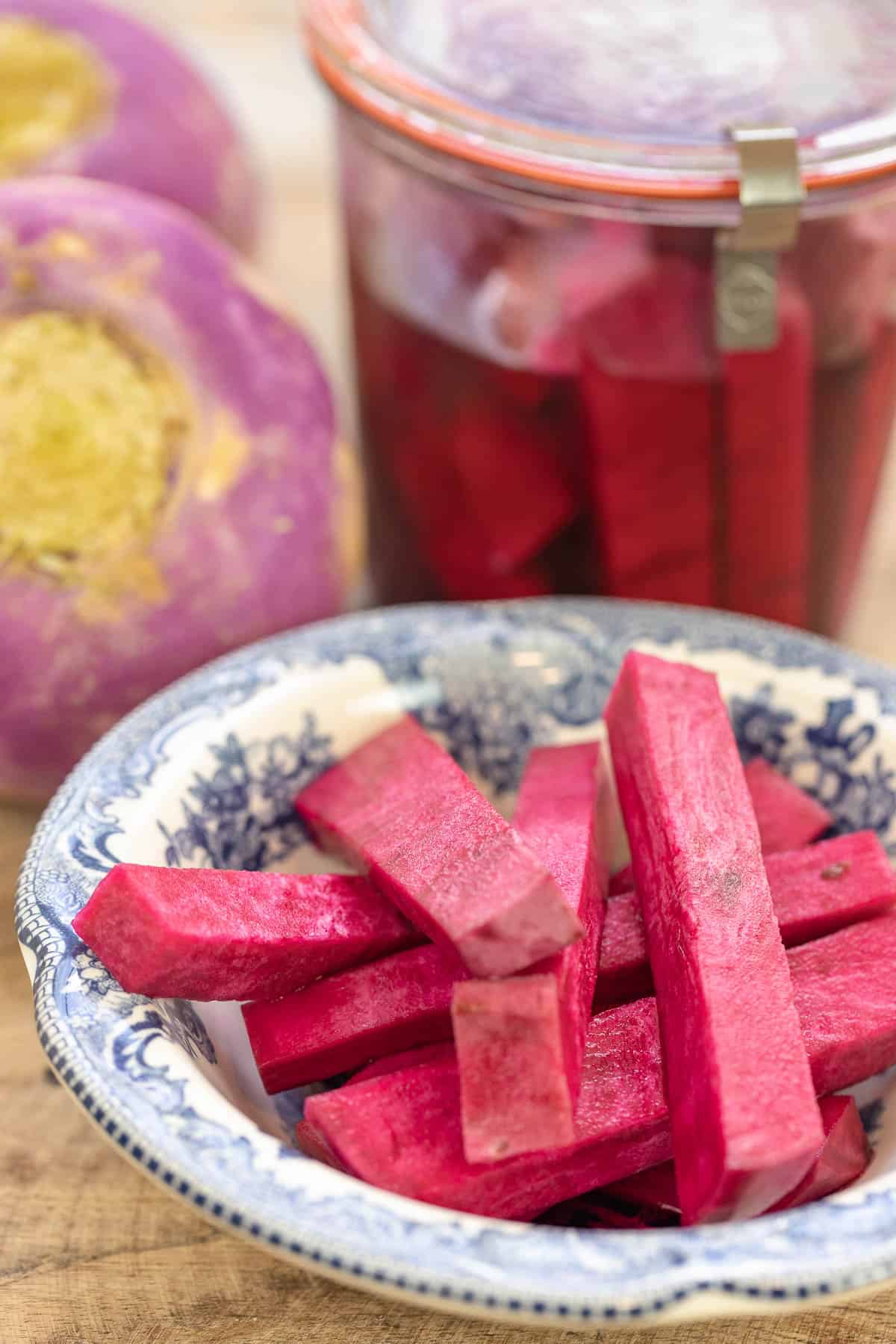
The Pink Pickles My Mother-in-Law Serves at Brunch
My mother-in-law Dina keeps jars of pickled turnips, pickled cucumbers, and preserved lemons for brunch. She serves them with foul mudammas, an Egyptian fava bean dish, labneh, a tangy strained yogurt, and boiled eggs. These pickles are my riff on hers: crisp, pleasantly sour, and tinted pink by the beet.
The hands-on work is quick. Stir together the brine, cut the turnips and beet into batons, and pack them into a jar. Then refrigerate for five days. I like them tucked into a falafel or shawarma pita, or simply set out with brunch as Dina does.
Ingredients for Pickled Turnips
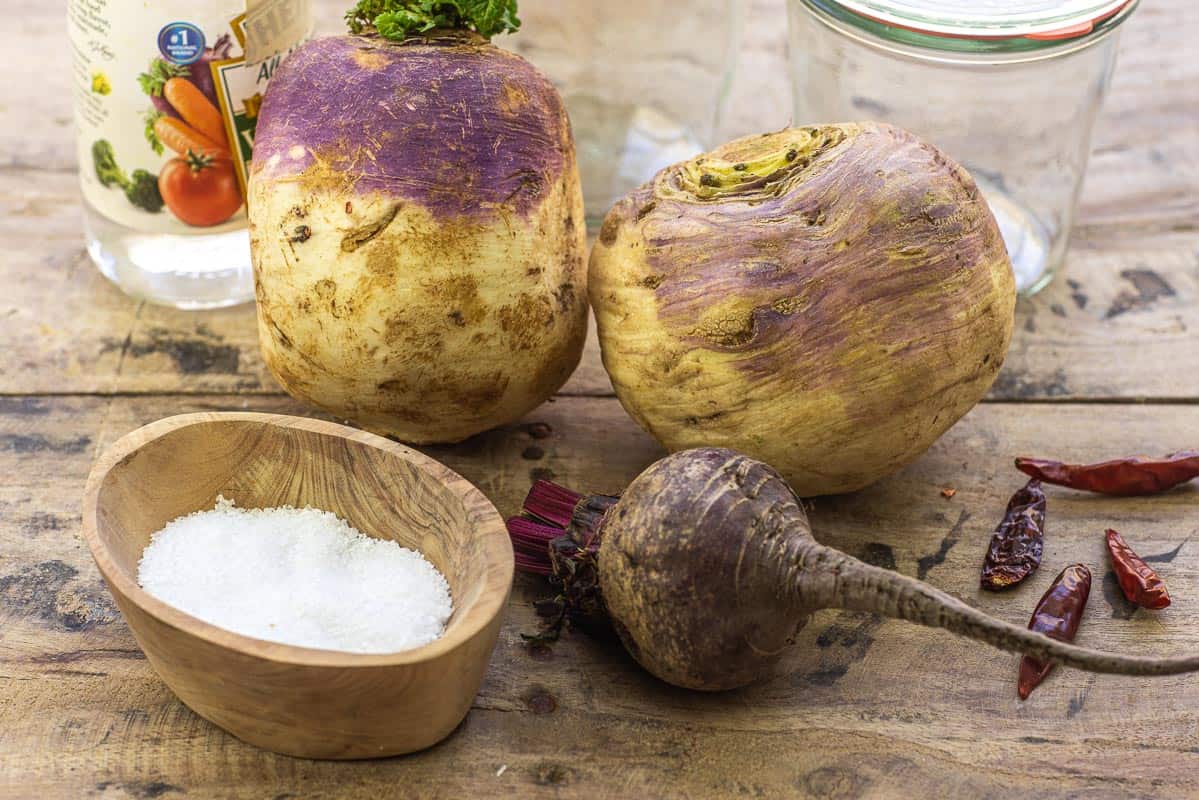
A beet gives the turnips their color, while vinegar and salt bring the tang. Here’s what you’ll need:
- Turnips: Choose firm turnips without soft brown spots. You’ll need about 2 pounds. Smaller turnips tend to be sweeter and milder, but large ones work well here.
- Beet: One small red beet is enough to tint the turnips pink. You can eat the pickled beet, too, though it will be chewier than the turnips.
- Distilled water: With distilled water, there’s no need to boil the brine. If you use tap water, boil it with the salt, stir in the vinegar, and let the brine cool completely before pouring it over the vegetables.
- Kosher salt: Use kosher salt rather than table salt for the brine.
- Distilled white vinegar: It gives the turnips their sharp, clean tang.
- Dried red chile peppers or red pepper flakes: Add these if you like a little heat.
How to Make Middle Eastern Pickled Turnips
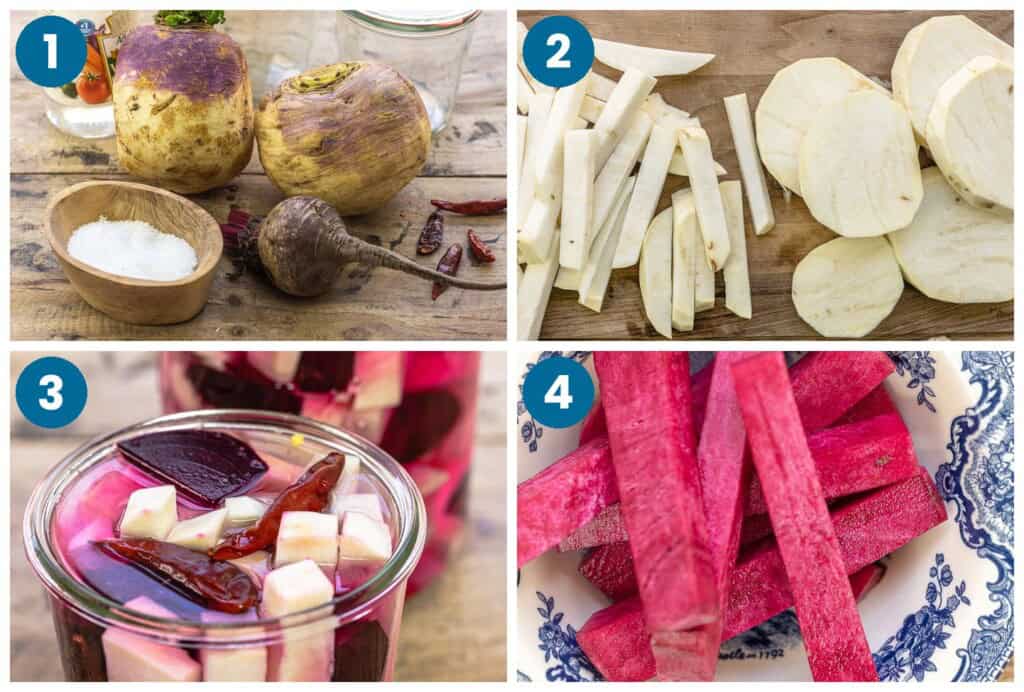
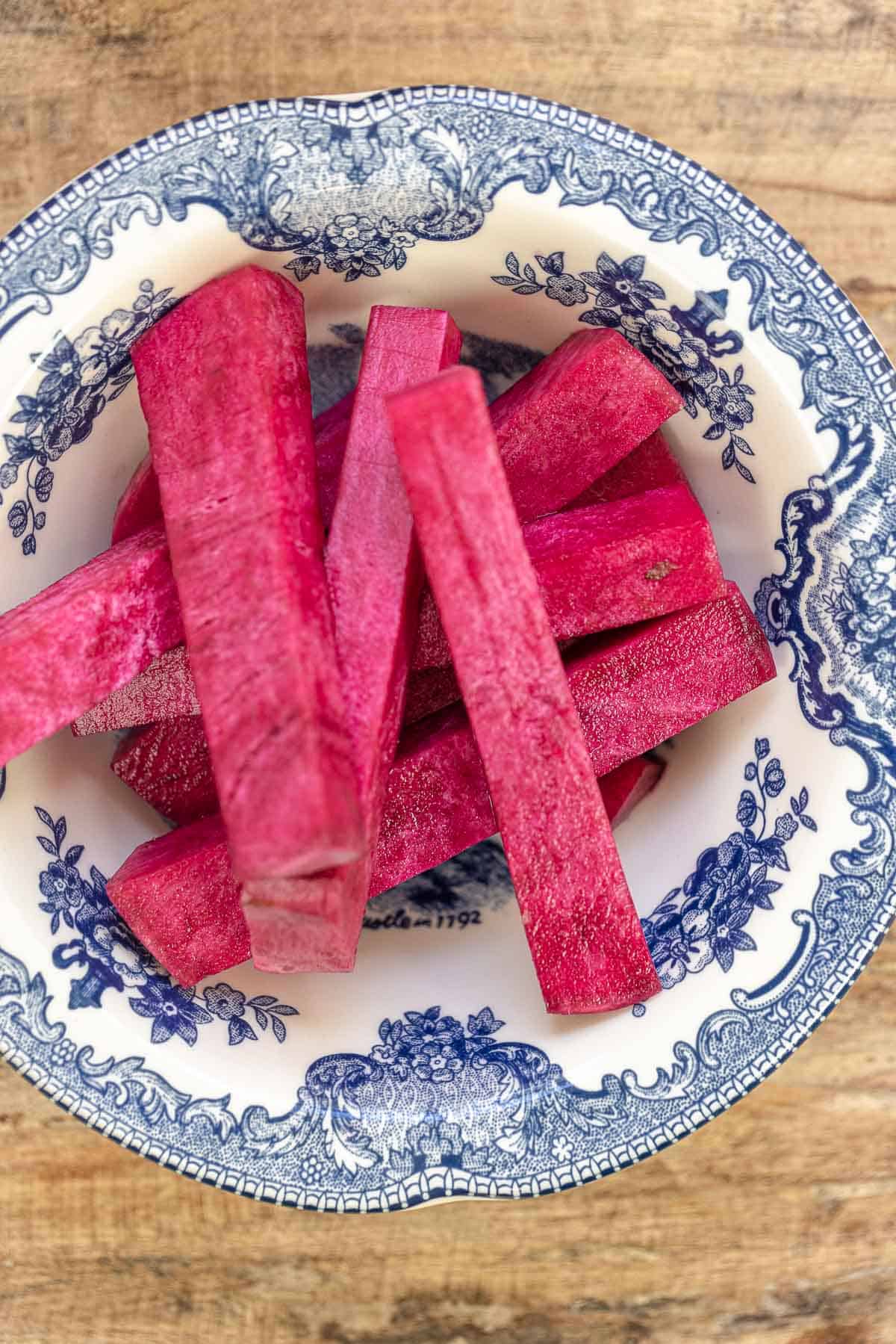
Cutting the vegetables into ½-inch-thick batons gives you pickle-sized pieces for snacking or tucking into a sandwich. A baton is simply a thick, stick-shaped cut.
- Mix the brine. Stir ¼ cup kosher salt into 3 cups distilled water until the salt dissolves. Stir in 1 cup distilled white vinegar.
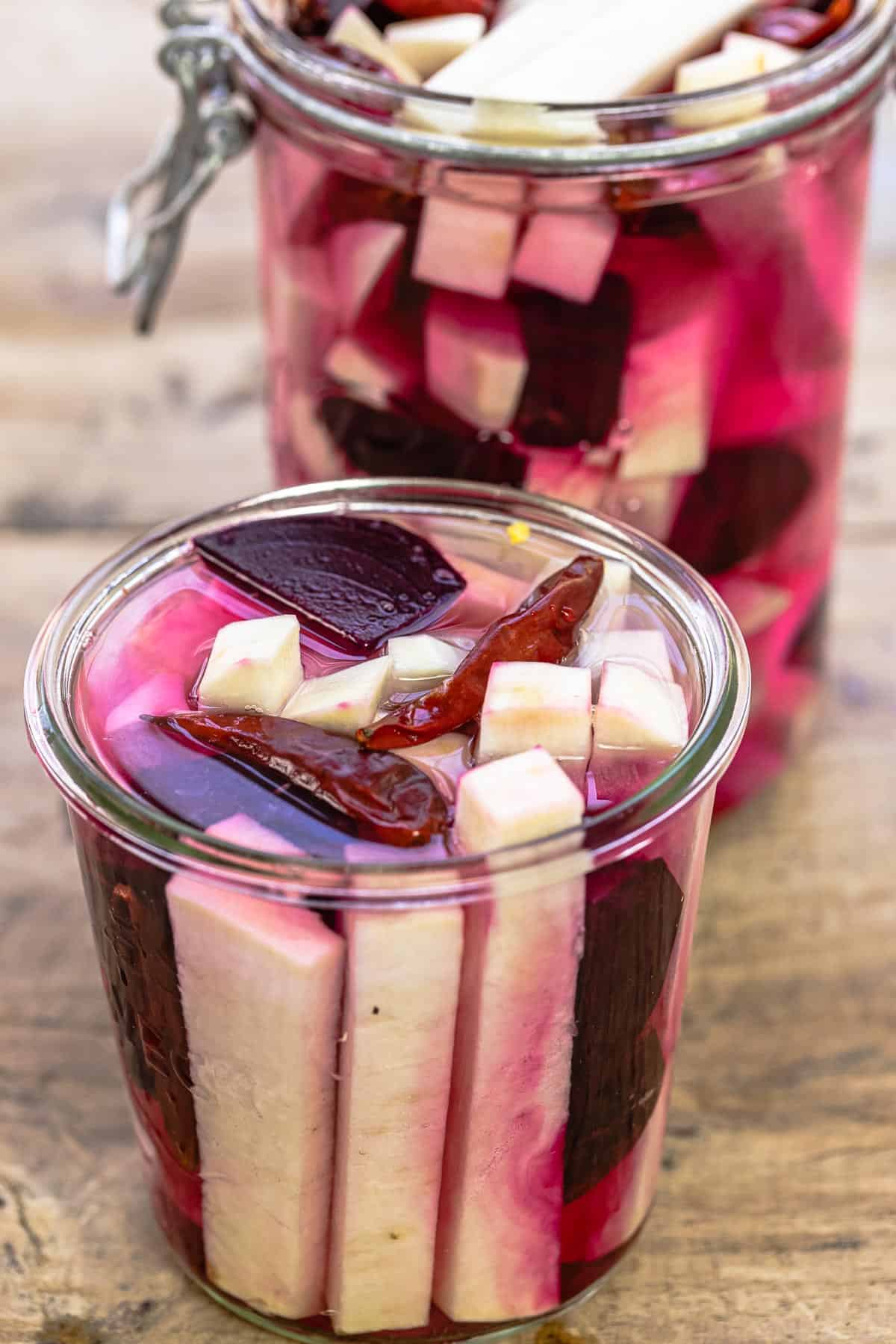
- Fill the jar. Peel 2 large turnips, about 2 pounds total, and 1 small beet. Cut both into ½-inch-thick batons and place them in a large mason jar with a lid. If you need two jars, divide the beet between them so both batches turn pink. Add dried red chile peppers or red pepper flakes, if using.
- Cover and refrigerate. Pour in the brine, making sure it covers the vegetables. Close the jar tightly and refrigerate for 5 days before serving.
Tips for Crisp, Pink Pickled Turnips
- Start with firm turnips. Fresh, crisp turnips give you the crunch you want after pickling. Pass over any with brown or soft spots.
- Put beet in every jar. If you divide the turnips between two jars, add some beet to each one for an even pink color.
- Give them the full five days. The brine needs time to flavor the turnips and turn them pink.
Ways to Change the Flavor
For a different flavor, add an aromatic to the jar:
- Bay leaves: Add 1 to 3.
- Garlic: Add 1 or 2 cloves, roughly chopped or sliced. Remove the garlic before serving.
- Whole spices: Try about 1 teaspoon of fennel seeds, coriander seeds, or peppercorns.
For a little heat, use the optional dried chiles or add ¼ to ½ teaspoon red pepper flakes.
What to Serve with Pickled Turnips
These tangy, crunchy pickles are especially good beside creamy dips and inside warm pita. Here are a few ways I serve them:
- Chop a few batons over a Mediterranean cucumber and tomato salad, or serve them alongside labneh and boiled eggs for brunch.
- Stuff them into homemade pita bread with falafel or chicken shawarma. Add a spoonful of tahini sauce.
- Set out a bowl on a mezze platter with hummus and olives.
How to Store Pickled Turnips
Keep the turnips in their brine in a tightly closed jar in the refrigerator for up to 1 month.
More Pickles and Mediterranean Condiments

Middle Eastern Pickled Turnips

Ingredients
- 3 cups distilled water
- ¼ cup kosher salt, do not use table salt
- 1 cup distilled white vinegar
- 2 large turnips, about 2 pounds, peeled and cut into ½-inch-thick batons
- 1 small beet, peeled and cut into 1/2 -inch-thick batons
- Dried red chili peppers or red pepper flakes, optional, to taste
Instructions
- Make the brine. In a large measuring cup or bowl with a pour spout, stir the kosher salt into the distilled water until completely dissolved. Stir in the vinegar.
- Fill the jar. Place the turnips and beet in a large mason jar with a lid. Use a second jar if needed, dividing the beet between the jars. Add the chile peppers or red pepper flakes, if using.
- Add the brine. Pour the brine over the vegetables, making sure they are fully covered.
- Refrigerate. Close the jar tightly and refrigerate for 5 days before serving.
Recipe Notes
- Using tap water: Combine the water and salt in a saucepan and bring to a boil, stirring until the salt dissolves. Stir in the vinegar and let the brine cool completely before pouring it over the vegetables.
- Salt: Use kosher salt, not table salt.
- Storage: Keep the turnips in their brine in a tightly closed jar in the refrigerator for up to 4 weeks.
- Serving: Add to falafel or shawarma pita sandwiches, set out with mezze, or serve alongside labneh and boiled eggs.
- Visit our shop to browse Mediterranean ingredients, including extra virgin olive oils and all-natural and organic spices.
Nutrition
Nutrition information is automatically calculated, so should only be used as an approximation.
Shop Suzy’s curated selection of Mediterranean olive oils, spices, and more.
Bundle and Save!
Four of our best-selling signature olive oils, perfect for everyday use.











Can’t wait to try
The recipe is quick and easy. I was so disappointed because the pickles were much too salty.
There is no way 3 cups of water and 1 cup of vinegar will cover all that stuff. Had to double the amount.
Hi Suzy.
Thanks for the terrific recipe.
There are two things in your recipe that I do not understand:
1. Why distilled water? Are you trying to avoid bacterial contamination? That’s the only reason I can think for boiling tap water if one is using tap water. If bacteria in the water is a concern, be aware that distilled water can also be contaminated with bacteria depending on how it has been handled.
2. The recipe calls for using kosher salt, rather than table salt, for the brine. I am guessing that this is to avoid the iodine content in table salt? Iodized salt is usually not recommended for salted foods which are fermented, such as sauerkraut, because the iodine will kill the probiotic bacteria that causes the fermentation. However, this is not a food which is meant to ferment, so I don’t see the value of kosher salt. So-called “kosher salt” is just a large grained, non-iodized, refined salt. If the salt is dissolved in water, the size of the grains becomes meaningless. I don’t see why the presence of iodine would make a difference in this recipe but I personally dislike the taste of iodized salt so I will use Himalayan pink salt or sea salt, as I always do, since both are extremely low in iodine content.
Cheers!
Flavius
Hello! Great questions! The reason distilled water is preferred is that it’s already free of chlorine, minerals, and other impurities that tap water contains. Those additives (especially chlorine) can affect both the flavor and the clarity of the brine. And, Suzy prefers Kosher salt here as it reduces any potential bitterness.
Thanks for the response to my questions. I did not think of the dissolved chemicals in tap water.
I wondered about boiling affecting the chlorine content of tap water. I have studied a fair bit of chemistry, so I did not understand how that would work, so I did some research.
It seems that boiling chlorinated tap water reduces “free chlorine”, that is to say chlorine gas and hypochlorous. However, boiling does not reduce substance known as “chloramines” very much. Free chlorine, used in many municipal supplies is volatile. When one heats or boils the water, free chlorine escapes as gas, so concentrations fall. Boiling for a few minutes will significantly reduce free chlorine. Longer boiling removes even more free chlorine and even allowing chlorinated water to sit open to air for about 24 hours, also allows free chlorine to off-gas. Note however that boiling tap water will not reduce the content of any non-volatile minerals in the water.
I have heard of people leaving water for house plants to sit for a day before watering their house plants. I am guessing that is why they do that.
So thanks for the chemistry lesson! 🙂
Cheers!
Flavius
Is it a turnip or swede you use
Hi, Dawn. You’ll want to us a turnip here. Hope you enjoy the recipe!
I have a huge jar of these that I purchased from the local middle eastern market that I used some for homemade shawarma. I have so much leftover and was just wondering what other dishes would this compliment? Google searches are inconclusive.
Hi Jeff! You can check out the section of the article here titled “All the ways to use pink pickled turnips!” for a ton of great suggestions. Can’t wait to hear what you try them on next!
Absolutely delicious
I would really like to make this pickle.
I’m in the UK and we don’t use cup measurements. Would you be able to provide the ingredients in millilitres (liquids) and teaspoons or tablespoons (salt)?
Thanks
Malka
Hi Malka. If you go to a search engine, you will find sites that will convert US or imperial (British) measurements to metric (also called The International System of Units or SI Units). I myself use the DuckDuckGo search engine but any search engine will do the task. If I want to know how many milliliters in a US cup for instance, I type “US cups to ml” in the search field and I am instantly taken to a page where I can have the conversion calculated for me. One can do that for any conversion from one measuring system to another: inches to millimeters; yards to meters; gallons to liters; etc. Just remember that there are US measurements that differ from the Imperial measurements. For instance a US gallon is smaller than an imperial gallon. Cheers! – Flavius
Cup is a 8oz. 1 oz is 28 grams or milliliters. 1 gram of water is 1 milliliter.
1/4 cup of salt is 72 grams.
Hi…. I made these, the brine is salty and not vinegary enough for me, is there a way to do this?
I’m sure there is, Kelly. You would just have to experiment with the vinegar and salt amounts until you get the flavor you’re looking for.
I would like to keep my pickled turnips a bit longer than a week. Is it possible to “Can” the product to keep it for several months/up to a year? If yes, is there anything different I need to do for the recipe, other than sterilizing the jars and lids etc? Thanks for your help!
Hi, Brian. That may be possible, but we’re not familiar with canning, so it’s hard to advise on how you would need to adjust the recipe.