



Bold, tangy, and perfectly crunchy, Middle Eastern pickled turnips are an easy condiment you’ll love on sandwiches, salads, mezze platters and more!
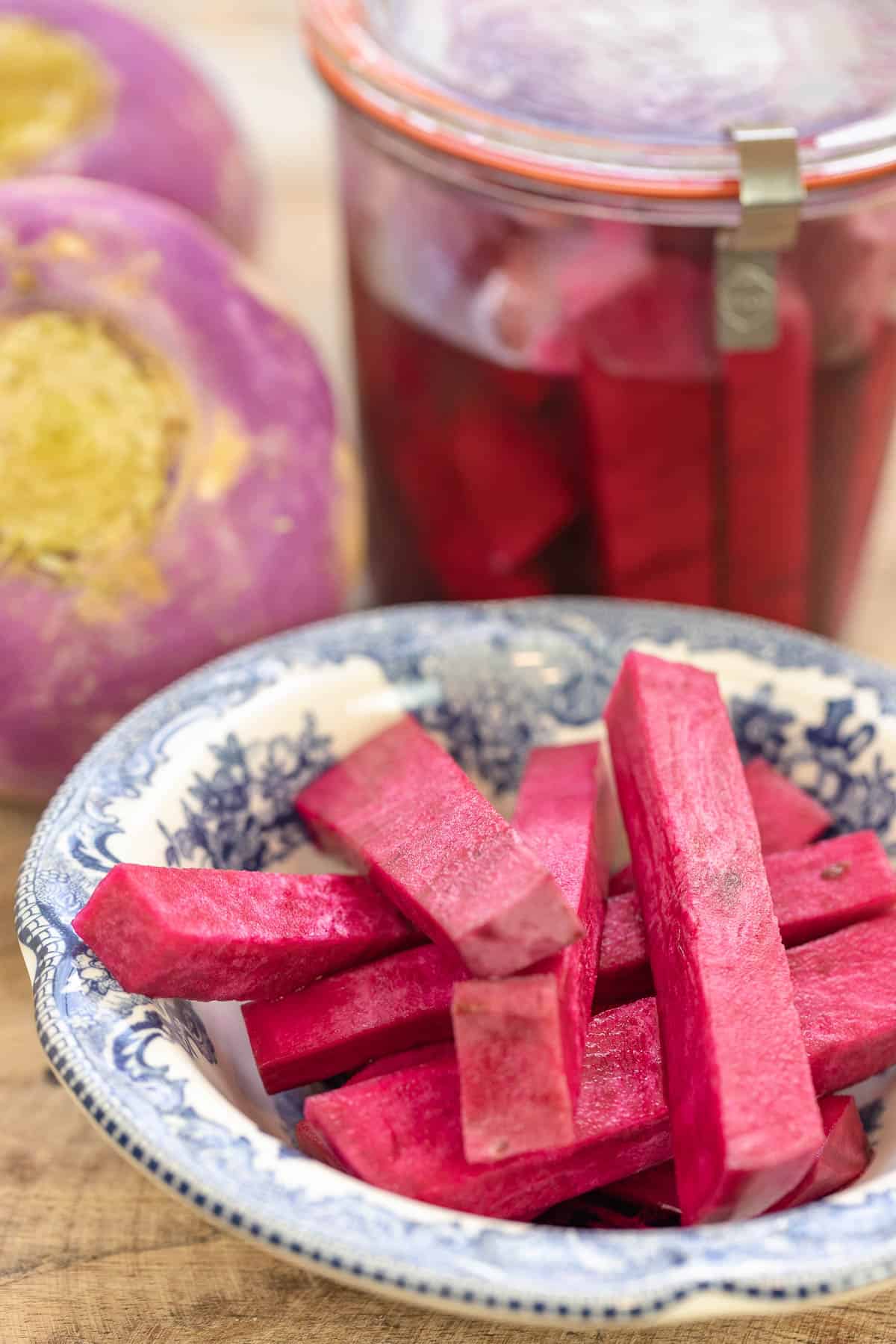
Pickled turnips
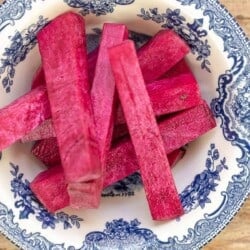
Beautiful pink pickled turnips are a staple in Middle Eastern kitchens. Perfectly vinegary, slightly sour, and subtly spicy, these crisp refrigerator pickles are easy to make in just 10 minutes. Simply brine, refrigerate, and let the magic happen.
This simple 6-ingredient recipe is a riff off of one from my mother-in-law Dina, who keeps jars of pickled turnips, pickled cucumbers, and preserved lemons to serve for brunch next to favorites like foul mudammas, tangy labneh, and boiled eggs.
Turnips (and beets, which are responsible for the beautiful magenta hue) + a quick brine make up this recipe…
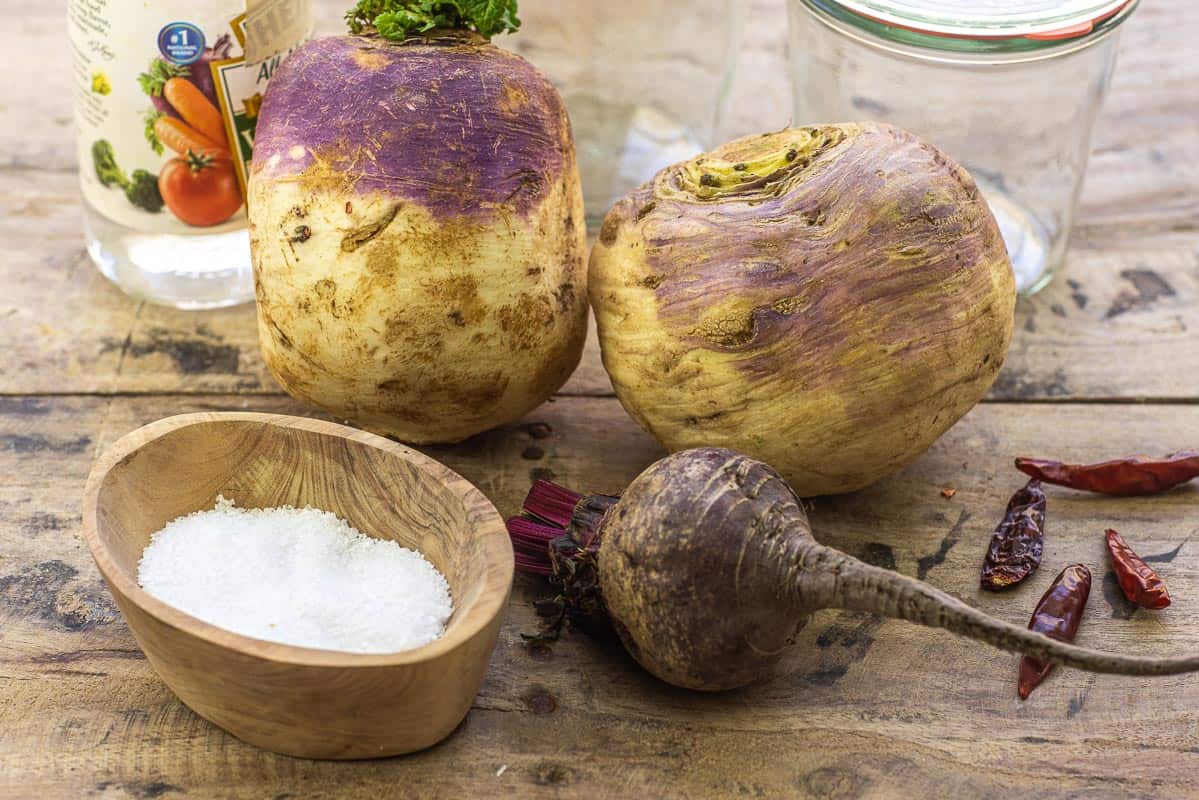
Turnips and beets
Turnips are root vegetables that are mostly white in color with a hint of lovely purple or pink skin. Younger, smaller turnips tend to be sweeter and more crisp, while older turnips have a sharper flavor. I use large turnips in this recipe, but you could use smaller ones as well – just get about 2 pounds! Avoid turnips with brown, soft spots. You need the turnips to be as fresh and crisp as possible so your pink pickles are nice and crunchy.
The secret to Middle Eastern pickled turnips’ pretty pink hue is red beets. You just need 1 small sliced beet, which is enough to tint the white turnips varying shades of pink.
Once the turnip pickle is ready, you can eat both the turnips and the beetroot. Just remember that the beets will not be crunchy – they will be chewy and a bit more rubbery.
The pickling brine
The brine is probably the most important part of this quick pickling process. Its strong flavor comes from salt and vinegar, which give the pickled turnips perfectly balanced tang and sourness.
This super easy brine takes just 3 simple ingredients and no boiling! Here’s what you’ll need to make it:
- Distilled water – If you use tap water instead, you will need to boil it first with the salt before you stir in the vinegar. Let it cool completely before adding the turnips and beets.
- Kosher salt – Do not use table salt. The turnip pickle will turn out really bitter.
- Distilled white vinegar – Vinegar’s acidity helps to preserve the turnips, and also gives them a really nice tang.
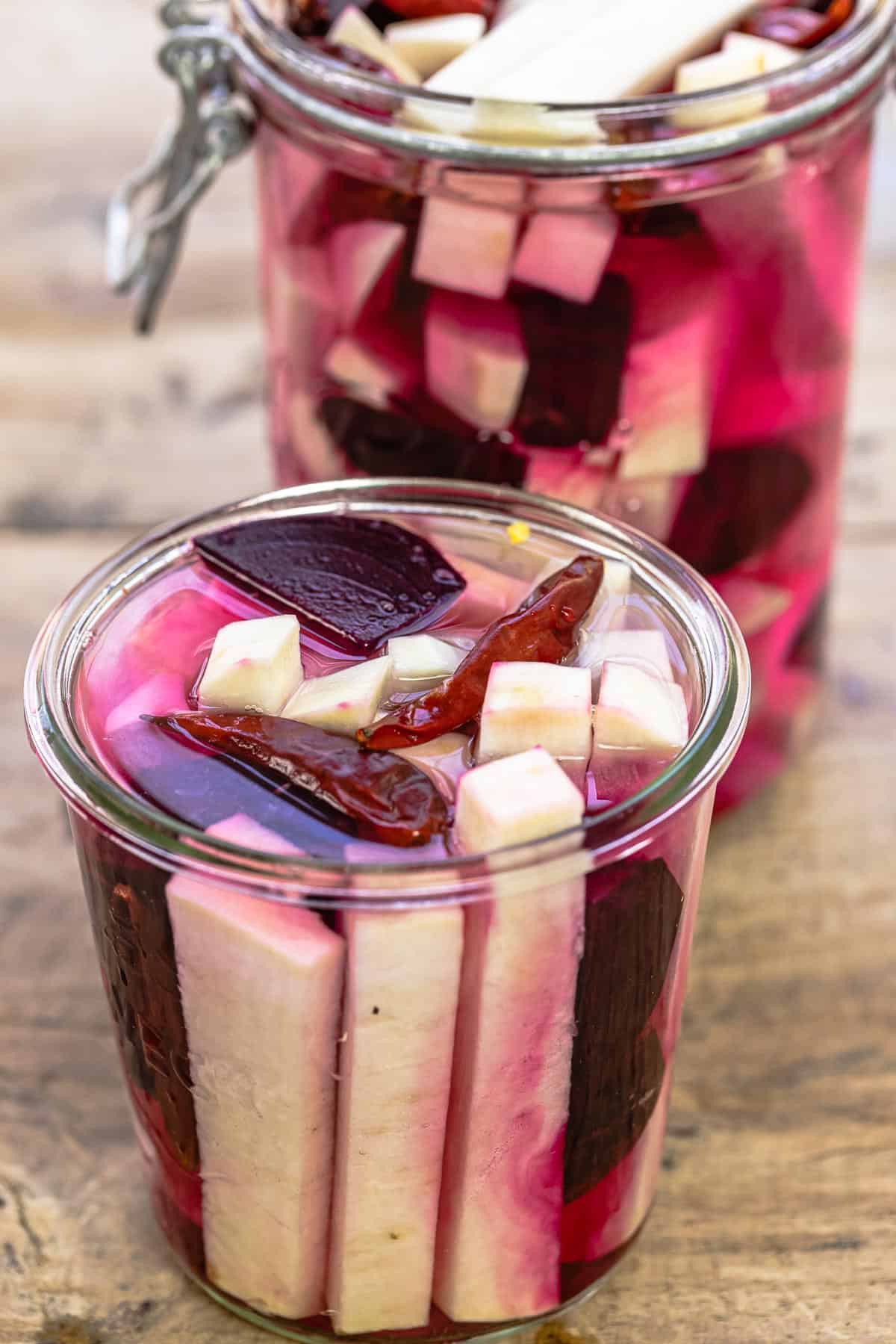
How to make Middle Eastern pickled turnips
Turnip pickle is so easy to make in just 3 steps! Here’s how:
- Make the brine. Combine 3 cups distilled water and ¼ cup kosher salt in a large cup or bowl with a pour spout. Stir vigorously until the salt has dissolved. Then stir in 1 cup distilled white vinegar. Set aside.
- Prepare the turnips and beets in a jar (or jars). Peel 2 large turnips and cut them into ½-inch-thick batons. Do the same with 1 small beet. Grab a large mason jar with a lid and place the vegetables inside. If you need to, use a second jar, but make sure each one has some beets in it, so all the turnips can turn a pretty pink. Add the chile peppers (or red pepper flakes), if using.
- Pickle the turnips. Pour the brine into the jar/s. The liquid should cover the vegetables completely. Close the mason jar tightly and refrigerate. After about 5 days, the Middle Eastern pickled turnips are ready to enjoy! You can eat the beets as well, but note that they will be more chewy and a little rubbery after pickling.
Variations
To change up the flavor of your pink pickles, you can add different herbs and aromatics. Play around and see what combination you like best!
- Bay leaves – You can use 1 to 3 bay leaves.
- Garlic – A clove of garlic or 2 (roughly chopped or sliced) imparts delicious flavor. Just don’t eat the garlic after it has been sitting in the pickling liquid! Trust me!
- Spices – A teaspoon or so of fennel seeds, coriander seeds, or peppercorns add even more Middle Eastern flair to pickled turnips.
- Red pepper flakes – If you don’t want to use chili peppers or jalapeno, but still want a little heat, ¼ to ½ teaspoon red pepper flakes is a great way to add a slight kick.
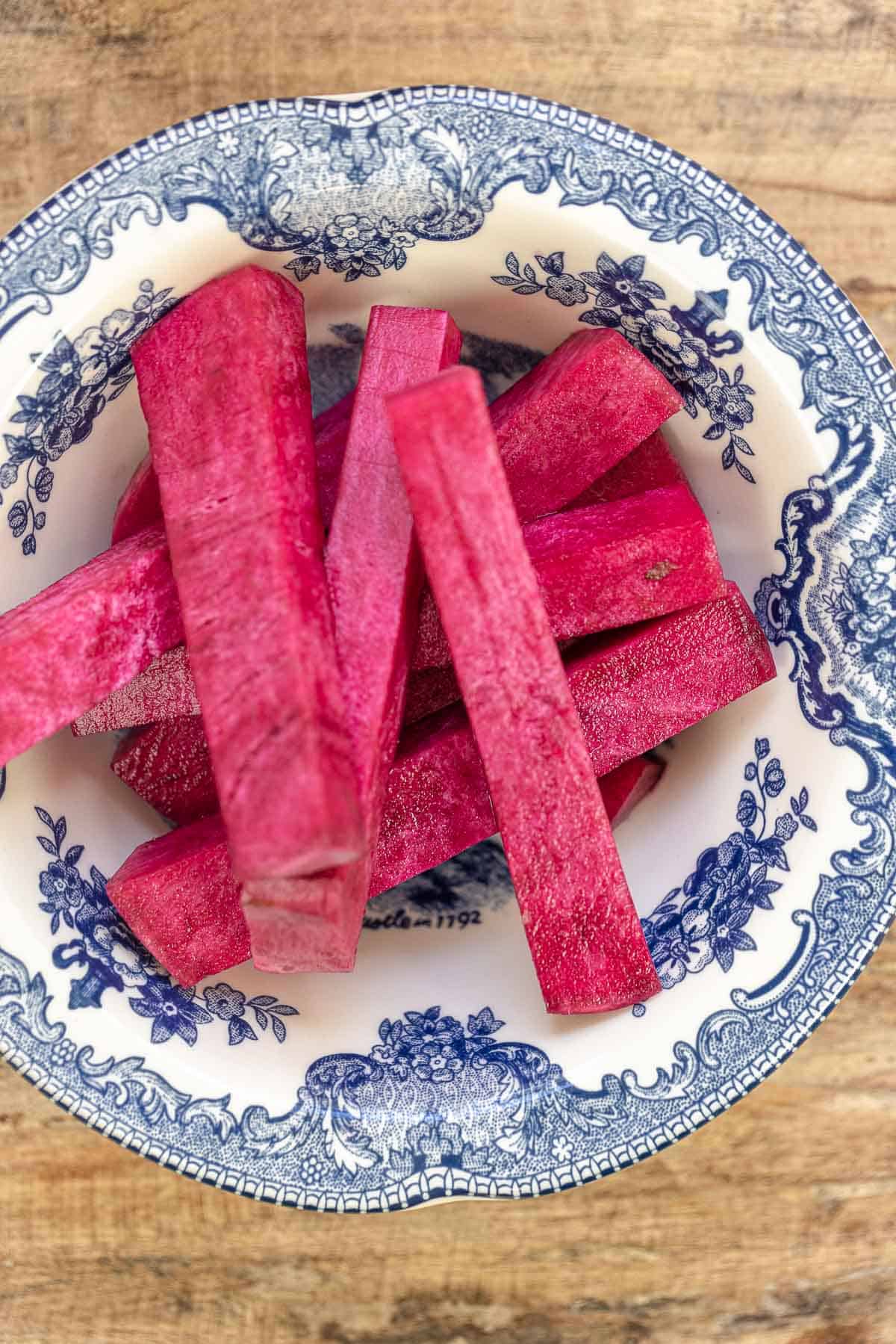
All the ways to use pink pickled turnips!
Trust me, once you try them, you’ll want to eat these pickled turnips with everything (or by themselves, straight out of the jar, like I do!) I like to stuff them into pita wraps with falafel or chicken shawarma, maybe with a Mediterranean cucumber and tomato salad and a drizzle of tahini sauce on top. Middle Eastern pickled turnips are also a delicious addition to a simple mezze platter alongside briny olives, roasted eggplant, and creamy hummus.
How to store pickled turnips
Middle Eastern turnip pickle can be stored in the refrigerator for up to 1 month. Be sure to close the lid tightly each time you grab some pink pickles to help them last longer.
More Mediterranean condiments
Moroccan and Tunisian
Preserved Lemons
Dips and Condiments
Quick Pickled Cucumber Recipe
Appetizer and Mezze
How to Roast Sweet Peppers (Two Ways!)
Appetizer and Mezze
5-Minute Marinated Feta
Browse all Mediterranean Recipes
Visit Our Shop

Ingredients
- 3 cups distilled water, see note if you want to use tap water
- ¼ cup kosher salt, do not use table salt
- 1 cup distilled white vinegar
- 2 large turnips, about 2 pounds, peeled and cut into ½-inch-thick batons
- 1 small beet, peeled and cut into 1/2 -inch-thick batons
- Dried red chili peppers or red pepper flakes, optional, to your liking
Instructions
- Make the brine. In a large measuring cup or a bowl with a pour spout, combine the distilled water and kosher salt. Stir until the salt has fully dissolved, then stir in the vinegar.
- In a large mason jar with a lid, arrange the turnips and beets (use two jars if you need to, making sure each jar has some beets for color). Add the chili peppers (or red pepper flakes), if using.
- Pour the brine into the jar/s, making sure the liquid covers the turnips all the way to the top.
- Cover the jar tightly and refrigerate for 5 days before using.
Video
Notes
- If using tap water to make the brine, combine the water and salt in a saucepan and bring to a boil, stirring until the salt has completely dissolved. Stir in the vinegar. Allow the liquid to cool completely and follow the recipe from step #2 on.
- Use kosher salt, not table salt, in the brine.
- Serving ideas: Pickled turnips go well with most Middle Eastern meals. Try it as part of a mezze platter, with shawarma, on a salad, or on the side of some boiled eggs and labneh.
- Storage: Pickled turnips in the brine will last in the fridge for about 4 weeks.
- Visit our Shop to browse Mediterranean ingredients including extra virgin olive oils and all-natural and organic spices.

Can’t wait to try
The recipe is quick and easy. I was so disappointed because the pickles were much too salty.
There is no way 3 cups of water and 1 cup of vinegar will cover all that stuff. Had to double the amount.
Hi Suzy.
Thanks for the terrific recipe.
There are two things in your recipe that I do not understand:
1. Why distilled water? Are you trying to avoid bacterial contamination? That’s the only reason I can think for boiling tap water if one is using tap water. If bacteria in the water is a concern, be aware that distilled water can also be contaminated with bacteria depending on how it has been handled.
2. The recipe calls for using kosher salt, rather than table salt, for the brine. I am guessing that this is to avoid the iodine content in table salt? Iodized salt is usually not recommended for salted foods which are fermented, such as sauerkraut, because the iodine will kill the probiotic bacteria that causes the fermentation. However, this is not a food which is meant to ferment, so I don’t see the value of kosher salt. So-called “kosher salt” is just a large grained, non-iodized, refined salt. If the salt is dissolved in water, the size of the grains becomes meaningless. I don’t see why the presence of iodine would make a difference in this recipe but I personally dislike the taste of iodized salt so I will use Himalayan pink salt or sea salt, as I always do, since both are extremely low in iodine content.
Cheers!
Flavius
Hello! Great questions! The reason distilled water is preferred is that it’s already free of chlorine, minerals, and other impurities that tap water contains. Those additives (especially chlorine) can affect both the flavor and the clarity of the brine. And, Suzy prefers Kosher salt here as it reduces any potential bitterness.
Thanks for the response to my questions. I did not think of the dissolved chemicals in tap water.
I wondered about boiling affecting the chlorine content of tap water. I have studied a fair bit of chemistry, so I did not understand how that would work, so I did some research.
It seems that boiling chlorinated tap water reduces “free chlorine”, that is to say chlorine gas and hypochlorous. However, boiling does not reduce substance known as “chloramines” very much. Free chlorine, used in many municipal supplies is volatile. When one heats or boils the water, free chlorine escapes as gas, so concentrations fall. Boiling for a few minutes will significantly reduce free chlorine. Longer boiling removes even more free chlorine and even allowing chlorinated water to sit open to air for about 24 hours, also allows free chlorine to off-gas. Note however that boiling tap water will not reduce the content of any non-volatile minerals in the water.
I have heard of people leaving water for house plants to sit for a day before watering their house plants. I am guessing that is why they do that.
So thanks for the chemistry lesson! 🙂
Cheers!
Flavius
Is it a turnip or swede you use
Hi, Dawn. You’ll want to us a turnip here. Hope you enjoy the recipe!
I have a huge jar of these that I purchased from the local middle eastern market that I used some for homemade shawarma. I have so much leftover and was just wondering what other dishes would this compliment? Google searches are inconclusive.
Hi Jeff! You can check out the section of the article here titled “All the ways to use pink pickled turnips!” for a ton of great suggestions. Can’t wait to hear what you try them on next!
Absolutely delicious
I would really like to make this pickle.
I’m in the UK and we don’t use cup measurements. Would you be able to provide the ingredients in millilitres (liquids) and teaspoons or tablespoons (salt)?
Thanks
Malka
Hi Malka. If you go to a search engine, you will find sites that will convert US or imperial (British) measurements to metric (also called The International System of Units or SI Units). I myself use the DuckDuckGo search engine but any search engine will do the task. If I want to know how many milliliters in a US cup for instance, I type “US cups to ml” in the search field and I am instantly taken to a page where I can have the conversion calculated for me. One can do that for any conversion from one measuring system to another: inches to millimeters; yards to meters; gallons to liters; etc. Just remember that there are US measurements that differ from the Imperial measurements. For instance a US gallon is smaller than an imperial gallon. Cheers! – Flavius
Cup is a 8oz. 1 oz is 28 grams or milliliters. 1 gram of water is 1 milliliter.
1/4 cup of salt is 72 grams.
Hi…. I made these, the brine is salty and not vinegary enough for me, is there a way to do this?
I’m sure there is, Kelly. You would just have to experiment with the vinegar and salt amounts until you get the flavor you’re looking for.
I would like to keep my pickled turnips a bit longer than a week. Is it possible to “Can” the product to keep it for several months/up to a year? If yes, is there anything different I need to do for the recipe, other than sterilizing the jars and lids etc? Thanks for your help!
Hi, Brian. That may be possible, but we’re not familiar with canning, so it’s hard to advise on how you would need to adjust the recipe.