Mlewi (Tunisian Flatbread)


This post may contain affiliate links. Please read our disclosure policy.
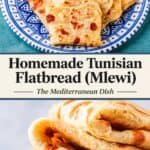
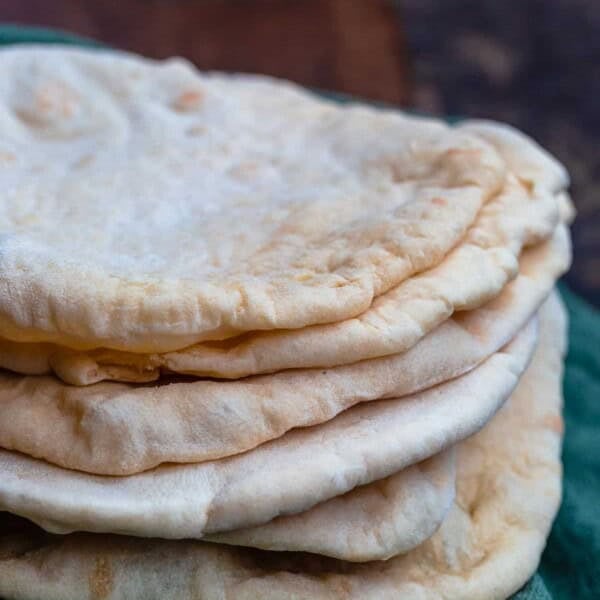
Mlewi (also spelled mlawi, ملاوي) is a flaky Tunisian flatbread you stretch and fold by hand. It’s soft enough to roll around a filling, and I especially like it warm with harissa, tuna, and egg.

How I Learned to Make Mlewi in Tunisia
I fell in love with slata tounsiya and brik au thon while I was living in Tunisia. Mlewi was the bread a Tunisian friend and I spent a whole week trying to get just right. A family member, a street vendor, and our teacher all had suggestions. Even a bus driver heard what we were up to and wanted to help. Tunisian generosity has no limits.
It took us nine tries. I like the slight grittiness that fine semolina gives mlewi, but I find that flatbreads made with semolina alone break too easily. A mix of semolina and all-purpose flour gave us what we wanted: flaky layers and a bread supple enough to fold around a filling.
Give the dough time to rest twice, 35 minutes in all. Then leave the rolling pin in the drawer. With a little olive oil on your fingertips, you can feel the dough stretch as you work.
What’s in This Tunisian Flatbread Recipe
This flatbread recipe uses pantry staples and some easy techniques to make a deliciously tender, flaky bread. Here’s what you need:

For the Mlewi Flatbread
- All-purpose flour: Creates a soft but also adequately strong and foldable dough.
- Semolina: Adds a nicely gritty texture and prevents sticking. Some recipes use only semolina, which ends up a bit harsher but nonetheless delicious. I find it then breaks too easily, so I use a combination of flours.
- Salt: Kosher salt enhances the flavor of the bread.
- Olive oil: Used liberally to prevent sticking, olive oil also imparts a nice flavor to the dough. I use high quality extra virgin olive oil for pretty much everything in my kitchen because it just tastes so much better.

How to Make This Flatbread Recipe
You can make this flatbread recipe by hand or with a stand mixer. Most importantly, don’t try to involve a rolling pin! It will bring a lot of frustration as the thin dough will stick and tear. Your fingers and a good amount of olive oil will work much better.
Make, Knead and Rest the Dough
- Make the dough. In a large mixing bowl, whisk together 350 grams (2 ½ cups) all-purpose flour, 215 grams (1 ½ cups) fine semolina, and 6 grams (1 teaspoon) salt. Using your hands to mix, add enough lukewarm water to bring together a shaggy dough, 380-400 grams (1 2/3 – 1 3/4 cups) of water in total.

- Knead the dough. Use a mixer on medium speed to knead the dough until smooth, about 5 minutes. Or, transfer the dough to a flat surface like the kitchen table or marble slab and use your hands to knead until nicely smooth and elastic, 5-10 minutes.
- Rest the dough. Form the dough into a ball and brush with olive oil all over. Return to a clean mixing bowl and cover with cling wrap. Set aside at room temperature to rest for about 30 minutes.


Divide, Shape and Cook the Flatbread
- Divide the dough. By now, the dough should have relaxed and spread around a bit. Divide into 8 rolls, set on a well-oiled surface (like a sheet tray coated with olive oil), and let rest for about 5 minutes.
- Spread the dough. Set up a work surface, like a clean countertop or extra large cutting board, with a layer of olive oil and place the bun in the middle. Dip your fingers in olive oil and start poking dimples in the dough to spread it around. Stretch the dough as much as you can. It’s ok if it tears a bit at this point. Attempt to make a shape similar to a circle.
- Begin to fold the dough. Pick up one side and fold it towards the middle.
- Make a square. Repeat with all four sides so you end up with an approximate square. Repeat with the remaining 7 dough rolls.
- Stretch the first square. Heat a large nonstick skillet over medium heat. Return the first square you folded to your oiled work surface. With oiled fingertips, gently stretch it to about 7 by 7 inches. Stop there. The dough will stretch a little more as you lift it, and a very thin square is hard to move in one piece.
- Cook the flatbreads. When a drop of water sizzles and quickly evaporates in the skillet, lift the square with both hands and lay it flat in the pan. The oil on the dough is enough to keep it from sticking. Cook for 1 to 2 minutes per side, until the bread is browned in spots and cooked through. Stretch and cook the remaining squares the same way, one at a time. Serve warm.


To Make Tunisian Flatbread Sandwich (Optional)

My favorite use for this flatbread recipe is to make a wrap. My go-to is tuna, egg, fries, cheese, harissa, and olives, which is so typical of Tunisian cuisine.
Ingredients and steps
- Harissa: This mildly spicy and very flavorful paste is really what gives Tunisian recipes their signature taste and a bit of a kick. It can be made at home, but even Tunisians most often just buy it. It’s quite easy to find in Arabic food stores, select grocers, or online at our shop. Start with using a little bit and work more in over time.
- Cream cheese: The original street food sandwich that inspired my recipe uses the Laughing Cow brand cheese, which is extremely popular in Tunisia. I find that cream cheese is a perfect substitute.
- Canned tuna in olive oil: Tastier than its water-packed counterpart.
- Black olives: Slice up your favorite olives or just get a jar of the already sliced variety.
- Homemade fries: Our Greek-style oven fries work perfectly.
- Hard-boiled eggs: Room temperature works best, so hard-boil the eggs a bit ahead of time so they have a chance to cool off. See our How to Boil Eggs guide for tips.
To make a Tunisian-style wrap
- Add your spreads. Spread the freshly cooked flatbread with cream cheese and harissa (stock up on our favorite harissa at our shop).
- Fill. Add a few homemade oven fries, sprinkle with drained oil-packed tuna, a hard-boiled egg, and sliced olives.
- Roll. Roll like a burrito and, optionally, wrap with foil to make it easier to eat. Enjoy!
More filling ideas:
Similar laminated flatbreads can also be found in nearby countries, like Msemmen in Morocco and Yemen, or even as far as India, although they are often eaten sweet with honey and perhaps fresh cheese.
In Tunisia, other fillings like turkey salami are also very popular. Feel free to experiment with the flavors you like and what you have on hand.
More Flatbread Recipes to Try
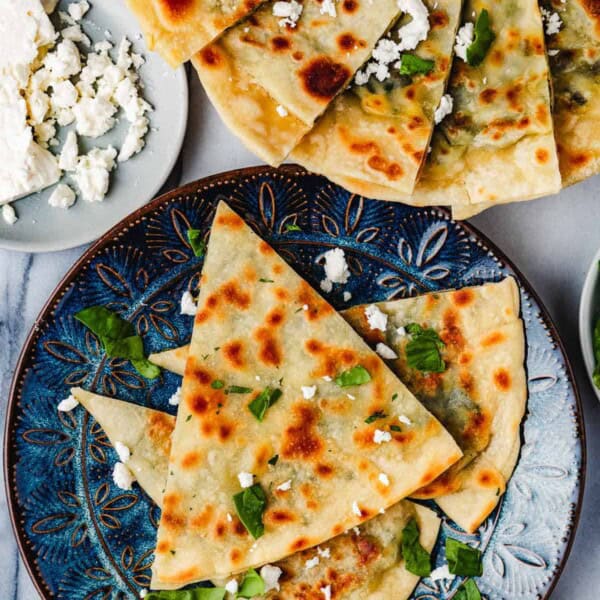
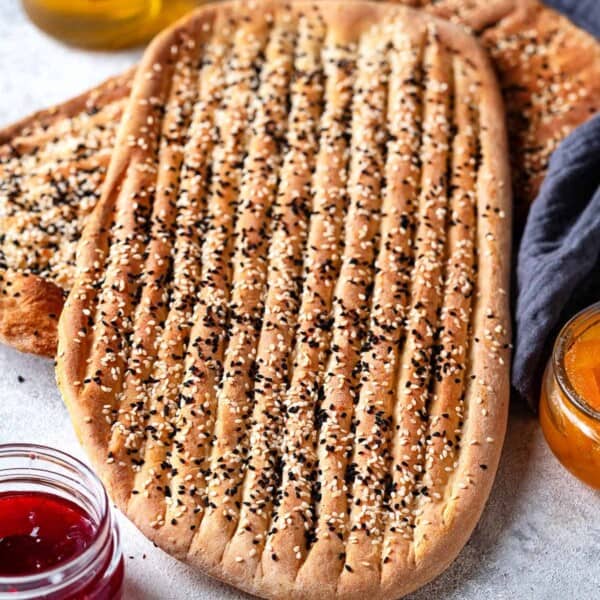

Mlewi (Tunisian Flatbread)

Ingredients
- 350 grams (2 ½ cups) all purpose flour
- 215 grams (1 ½ cups) fine semolina flour
- 6 grams 1 teaspoon salt
- 380-400 grams (1 ⅔ – 1 ¾ cups) lukewarm water
- Extra virgin olive oil, to prevent sticking
Instructions
- Make the dough. In a large mixing bowl, use your hands to mix the flour, semolina flour, and salt. Add the water and mix until a shaggy dough comes together, adding more as necessary to bring the dough together.
- Knead the dough. Use a mixer on medium speed to knead the dough until smooth, about 5 minutes. Or, transfer the dough to a flat surface like the kitchen table or a marble slab and use your hands to knead until nicely smooth and elastic, 5-10 minutes.
- Rest the dough. Form the dough into a ball and brush with olive oil all over. Return to a clean mixing bowl and cover with cling wrap. Set aside at room temperature to rest for about 30 minutes.
- Divide the dough. By now, the dough should have relaxed and spread around a bit. Divide into 8 rolls, set on a well-oiled surface (like a sheet tray coated with olive oil), and let rest for about 5 minutes.
- Spread the dough. Set up a work surface, like a clean countertop or extra large cutting board, with a layer of olive oil and place the bun in the middle. Dip your fingers in olive oil and start poking dimples in the dough to spread it around. Stretch the dough as much as you can. It's ok if it tears a bit at this point. Attempt to make a shape similar to a circle.
- Shape the dough. Pick up one side and fold it towards the middle, repeat with all four sides so you end up with an approximate square. Repeat with the remaining 7 dough rolls.
- Stretch the first square. Heat a large nonstick skillet over medium heat. Return the first square you folded to your oiled work surface. With oiled fingertips, gently stretch it to about 7 by 7 inches. Stop there. The dough will stretch a little more as you lift it, and a very thin square is hard to move in one piece.
- Cook the flatbreads. When a drop of water sizzles and quickly evaporates in the skillet, lift the square with both hands and lay it flat in the pan. The oil on the dough is enough to keep it from sticking. Cook for 1 to 2 minutes per side, until the bread is browned in spots and cooked through. Stretch and cook the remaining squares the same way, one at a time. Serve warm.
- Use or store. Use immediately or wrap in plastic to prevent drying and store for up to 3 days
Recipe Notes
- Don’t even think about using a rolling pin to stretch the dough.
The dough will keep retracting and tearing, and the process will be extremely frustrating. Well-oiled fingers work like a charm, and stretching the dough by hand is easy and effective. - Don’t make the dough extremely thin, as it will become increasingly hard to transfer to your pan. A size of about 7″x7″ works perfectly since the dough still stretches a bit while you move it, and you end up with 8″x8″ flatbreads.
- Make sure your pan is bigger than 8″x8″ in order to bake the whole flatbread evenly. I love to use a large crepe pan, but any large non-stick pan will do.
- Olive oil for shaping: Pour a little Arbequina extra virgin olive oil into a small bowl so you can dip your fingertips as you stretch and fold each piece of dough.
Nutrition
Nutrition information is automatically calculated, so should only be used as an approximation.
Shop Suzy’s curated selection of Mediterranean olive oils, spices, and more.
Bundle and Save!
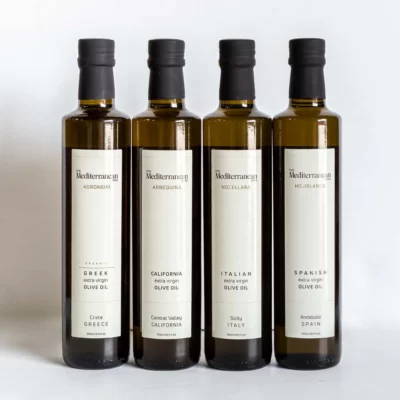
Be sure to check out our Everyday EVOO Bundle — four signature branded olive oils that are perfect for everyday use.










If I only want to make 4 flatbreads would using just half all ingredients work? Is all purpose flour (U.S) the same as plain white flour (U.K)?
Hi, Glen — I’m Summer and I work here at The Mediterranean Dish. Great questions. Yes, you can halve the ingredients to make half the recipe, and you are correct. All Purpose Flour in the U.S. is the same as plain flour in the U.K. Happy Baking!
Mlewi is my fav dish
Mine came out not fully cooked through either as Claudia stated. So I cooked them longer and they inner texture was just awful. They were very heavy and dense.
I’ve made this recipe twice, and while the flatbreads are tasty, mine are not fully cooked through. I’ve tried lowering the heat, increasing the time, cutting the flatbreads in half before cooking them, but nothing works. I’ve followed the recipe exactly. Do you have any suggestions? Thanks!
I’m so grateful you’re posting more Tunisian recipes! My husband’s parents came from Tunisia and passed too early for him to learn to cook the dishes he loved as a child. We find a lot of recipes in French but it’s been hard to get nice, authentic Tunisian recipes in English. We are so excited to make the Brick and this one soon, too! Thank you so much, Susy!
Hi, Lizzie and Salim! I’m Summer and I work with Suzy. Thank you for letting us know you’re enjoying the Tunisian recipes. We will do our best to keep them coming. If there is a specific recipe you’re after please let us know! Maybe we can figure out how to make it.